

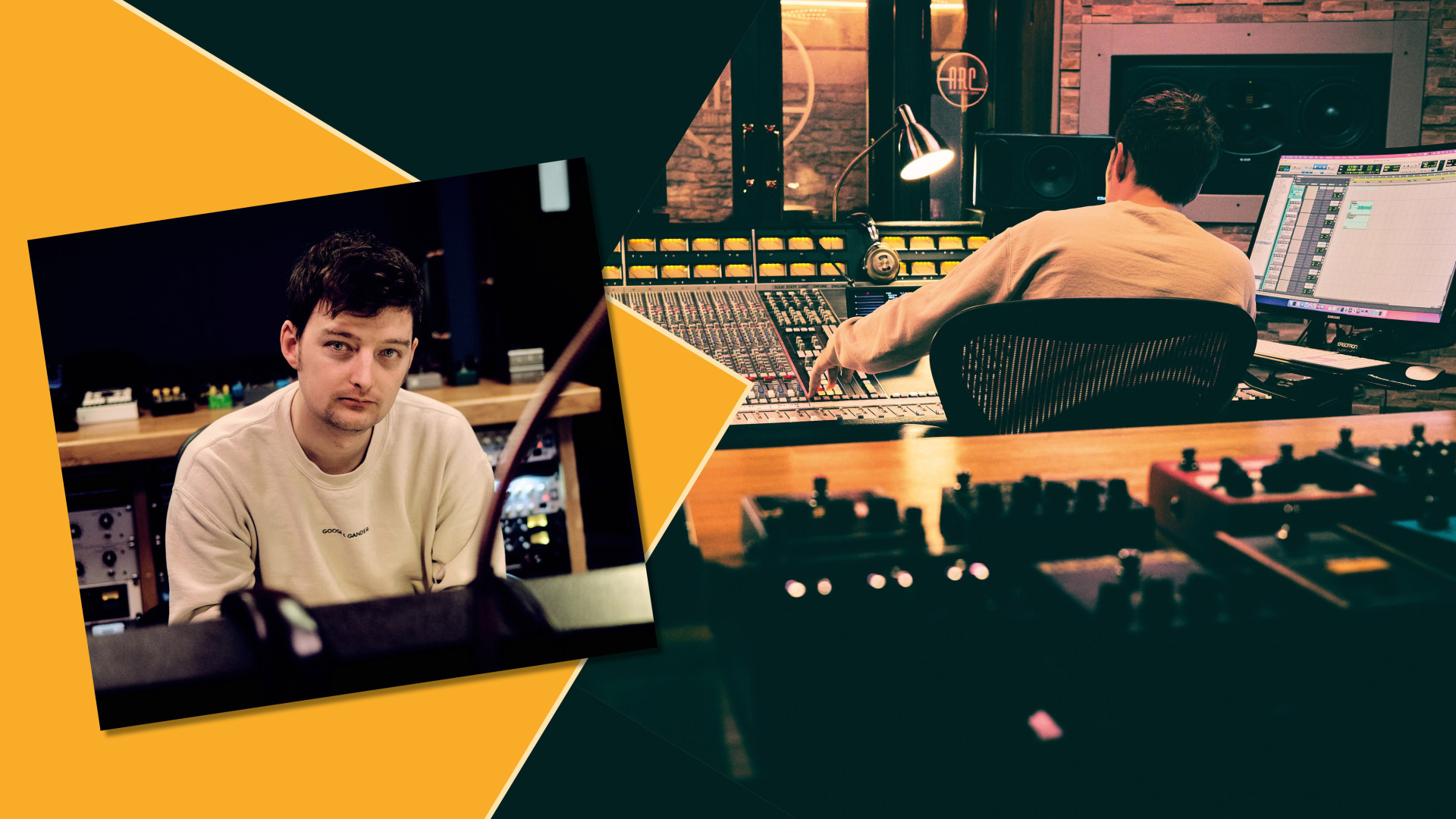
Deep in the heart of Oxfordshire music happens. In a Cotswold stone building, there is 1,000 sq foot space where recording magic takes place. Among the gorgeous coffee shops and adventurous hairdressers gentrifying Eynsham, a rather wonderful development houses a recording studio with a 32-year-old recording engineer called Matt Taylor who has worked with Tony Iommi, Frank Turner and even the Gruffalo writer Julia Donaldson, to name a few.
In a world of money-grubbing and everything maxxing, it was very reassuring to spend a morning chatting with this extraordinary young man whose work has resulted in ARC (Abbey Recording Company) Recording Studios being named as Finalists in the Music Producers Guild 2026 Small Studio of the Year, with Matt himself the winner of the 2022 Rising Star Award.
When I heard about the studio, an image of Rockfield came to mind – the legendary studio in Monmouth where the likes of Black Sabbath, Oasis and Queen laid down seminal albums. And indeed Abbey studios is also residential, so artists and musicians can come and stay in an adjacent apartment which sleeps up to seven, meaning a band can tumble out of bed – revived with excellent local coffee – and get to creating a new opus.
I could amaze you with all the equipment and recording capacity of the studio: it has a 32-channel SSL 4000 G+ mixing desk renovated by Keith Skerret at Recycled Audio composed of channels from Peter Gabriel’s G series and Sir George Martin’s E series. However, it would be fair to say I’ve no idea what I’m talking about… What I want to tell you about is Matt himself, whose extraordinary story of adversity and resilience is the spark which I believe allows creative people to come to this space and collectively make wonderful things for our aural delight.
Matt Taylor was born into a troubled family on the Isle of Man, which ultimately led him to be placed into the care system at the age of 13 following the death of his father when his mother was formally charged with neglect. Right at the beginning of our chat, Matt told me that the statistics for boys who grow up in children's homes reveal that 56% end up in prison or dead before the age of 21. “I was already off the rails,” he told me, “I just had parents who didn't know how to look after children. They weren't bad people... Once I went into care, my relationship with my mother got better”.
Matt is upbeat, open and positive, with a curious lack of bitterness as he goes on to explain that although care homes are ‘crazy hard’, it was exactly the right place for him. Without it he never would have got onto the path to music and the subsequent support that goes along with it.
His introduction to music was one of those conversely serendipitous moments when things were kicking off so badly at the home that Matt, then aged 15, was on the verge of doing a runner. There was a guitar in the home that was rather badly treated – generally just being thrown about when one of the boys was having a tantrum. But, on this particular occasion an on-duty caseworker called Dave picked up the poor mis-used instrument and showed Matt how to strum out some chords to a song he liked. “That was the little tap I needed,” Matt explains, “I was trying to teach my fingers to do these shapes, 10 hours passed, and the next day I was doing it again, and the next day. Trying to play guitar, suddenly I was no longer in unsafe friend groups dealing drugs, smashing windows and getting arrested.”
He didn't have access to any music lessons, so he’d look at chord charts to see how to do a chord, listen to it and try to emulate the rhythm of songs. He couldn't read, so he wasn’t writing songs, just strumming chords and singing random words and remembering them in his head. Wait – he couldn’t read? I had to take a moment digest this.
No, Matt informs me, he didn’t know how to read until he left care. When he turned 18, the system booted him out to live in a random rented room, or ‘supported lodgings’ in a house belonging to a woman called Fiona, whom Matt affectionately calls Fifi. He’d enrolled on a BTEC in Music Technology, but although he’d learned the alphabet, the trauma of his upbringing meant he lacked the communicative ability to read or put words together into a form that held any kind of meaning for him. He’s been tested for dyslexia and spectrum disorders. It wasn’t that: trauma, plain and (not so) simple, had given him some kind of block.
He was supposed to write essays for his BTEC, so he asked Fifi for help. Over the course of a year she spent many – many – hours and numerous daily phone calls explaining textual meaning. Gradually, Matt learned to read and write. He tells me rather shamefacedly that he didn’t exactly reward this with gratitude right away. He had a relapse, stole money off Fifi and went (momentarily) off the rails with drugs and antisocial behaviour. When he ended up in magistrates’ court, contrary to advice from family and social services alike, Fifi stood up for him. Every adult in his life had let him down, she explained to the judge, so she was not going to do that. She was going to take him back home, stand by him, give him unconditional love and another chance to turn his life around.
“I haven't touched any drugs or alcohol since, and no offending behaviour either. Sometimes you need that reprieve moment. I thought, well if she's willing to do that, then maybe I can't be so angry anymore”.
Matt completed his course, then went on to LIPA (the Liverpool Institute of Performing Arts), or “the Paul McCartney place”, as he refers to it, and graduated with a BA in Sound Technology. That was in 2019. He saw an ad for a Recording Engineer at the newly opened Abbey studios and applied. During his interview he told the owner (another Dave!) all about his background. Dave simply said, ‘You can come. I'll give you a salary, I'll give you a room to stay, you can have a car to go back up north to see your family [his mother and girlfriend still live in Buxton] whatever you need, I'll make it happen’.
Of course we all know what took place after the end of 2019… However Matt recounts that the studio was a wonderful place to be locked down. Recording studios didn’t exactly have to shut down during the Covid times, particularly smaller manageable spaces. So Abbey studios was able to pick up some rather remarkable projects.
I’ll leave you to google his work with the likes of Frank Turner, KT Tunstall et al, but I will share an amusing insight into what it was like working with hard rock legend Tony Iommi; “it wasn’t as exciting as you might think,” Matt laughs, “he’s an older bloke, really rather set in his ways. He mainly shuffled about and did his own thing – I didn’t have to do that much”. In a funny way, I think Tony Iommi, would rather enjoy this description.
I finish the interview by asking Matt what he thinks it is that gives him the insight to draw the best out of recording artists. He asks me if I’ve read a book called Poverty Safari by Darren McGarvey, which explains that people from violent backgrounds develop a sort of hypervigilance that teaches them how to be super aware. For Matt this hypervigilance has become the skill that makes him a good recording engineer: “I can hear what someone's actually feeling by the tone of their singing so it’s useful when you're trying to get someone to sing with real emotion. It’s a transferable skill”.
As well as being an award-winning recording engineer, Matt is just about to graduate with a Masters in Creative Writing from Oxford University. He’s been writing a novel about his upbringing, and you can read his short-form writing on his Substack. He tells me that it was a little daunting applying and attending Oxford, but he was reassured when he found out that both his tutor and the architect of the college library [Kellogg College] were both brought up in the care system.