



It’s rather thrilling that within Oxford there is a secret, swallowed village. A haven belonging to a bygone world encircled by Oxford's urban sprawl. As the summer turns its face towards autumn and the days grow cooler and shorter, one might not fancy going too far afield for an adventure, so a historical jaunt into the past, right on one’s doorstep, might just appeal very nicely.
From the London Road, you can simply journey down Old High Street, take a left down St Andrew’s Lane and the bustling city vanishes as you are surrounded by narrow lanes brimming with thatched rubble-stone cottages, of which the delightfully named Pumpkin Cottage is a particularly fine example. There are also a good few grand Georgian houses laid out elegantly behind the fine stone-built walls lining the lane. Here, you could squint your eyes and really believe that you had been transported back to the 18th century with an Austen-type drama unfolding around you, for that is what Old Headington feels like. It’s incredibly photogenic and packed with architectural history.
The old village hub is surely St Andrew’s Church, which dates back to the 12th century and has a distinct Norman chancel arch. Nearby is The White Hart, a classic local tavern that typifies the area's nostalgic vibe.
Old Headington can trace its roots way back to the time when Oxford proper was a mere bog, evidenced by numerous archaeological discoveries of interest. Pottery found on the Manor Ground revealed that there had been an Iron Age settlement there about 600 BC. An excavated Roman kiln, now on display in the Museum of Oxford, shows that the area was a major manufacturing centre around AD 300 and exported clay pots as far as northern Europe. Bones found in a Stephen Road garden revealed an Anglo-Saxon burial ground there, dating from around AD 500.
The name Headington or ‘Hedena’s dun’ (hill) itself is a clue to the village’s Saxon heritage. By the early eleventh century King Æthelred II (he who was unfortunately known for being Unready) had a royal residence there, and in 1004 kindly granted local land to St Frideswide’s Priory.
After the Norman conquest, however, Headington was overtaken in size by Oxford, which was founded around 900 and by 1200 had a growing community of scholars.
Old Headington was now off the beaten track, reached from Oxford via Cuckoo Lane, but it remained a village in function and character through the medieval period and up to the end of the 18th century. Oxford officially absorbed the area in 1929, and by then some of its streets had been renamed to prevent confusion. For instance, what is now Old High Street was originally just called High Street, and Osler Road was known as Sandy Lane.
A pleasant half-hour loop around Old Headington provides a short, highly scenic walk covering the hidden village’s major highlights:
Step 1: Start at the White Hart Pub (Old High Street). This 17th century tavern is the perfect anchor point. Face the pub and head right down St Andrew's Lane.
Step 2: St Andrew's Lane. This is the most photographed street. Walk slowly past the towering stone boundary walls, low doorways, and Pumpkin Cottage (the famous thatched house).
Step 3: St Andrew’s Church. The lane naturally curves toward the 12th century Norman church. Step inside the churchyard to view ancient headstones and the beautiful mature trees.
Step 4: The Secret Footpath (Larkins Lane). From the churchyard, find the entrance to Larkins Lane. This incredibly narrow, stone-walled pedestrian alleyway feels completely medieval. Follow it as it winds past hidden gardens.
Step 5: Dunstan Road and Osler Road. Larkins Lane pops you out onto Dunstan Road. Turn left, then take another left onto Osler Road to head back south. You will pass magnificent old stone manors, including Headington House.
Step 6: Finish at Bury Knowle Park. Osler Road leads you right back to the Old High Street. Finish your walk by wandering through the gorgeous gardens of Bury Knowle Park, which features a historic library building and unique wood sculptures.
If this trot around Old Headington has whetted your appetite, you might fancy venturing further afield, down London Road toward Headington Quarry, for an exploration of a very different village. Stone was quarried here for centuries, and the workers’ cottages were built haphazardly inside the old pits, creating a maze of sunken, winding footpaths known as The Dips that are incredibly fun to explore.
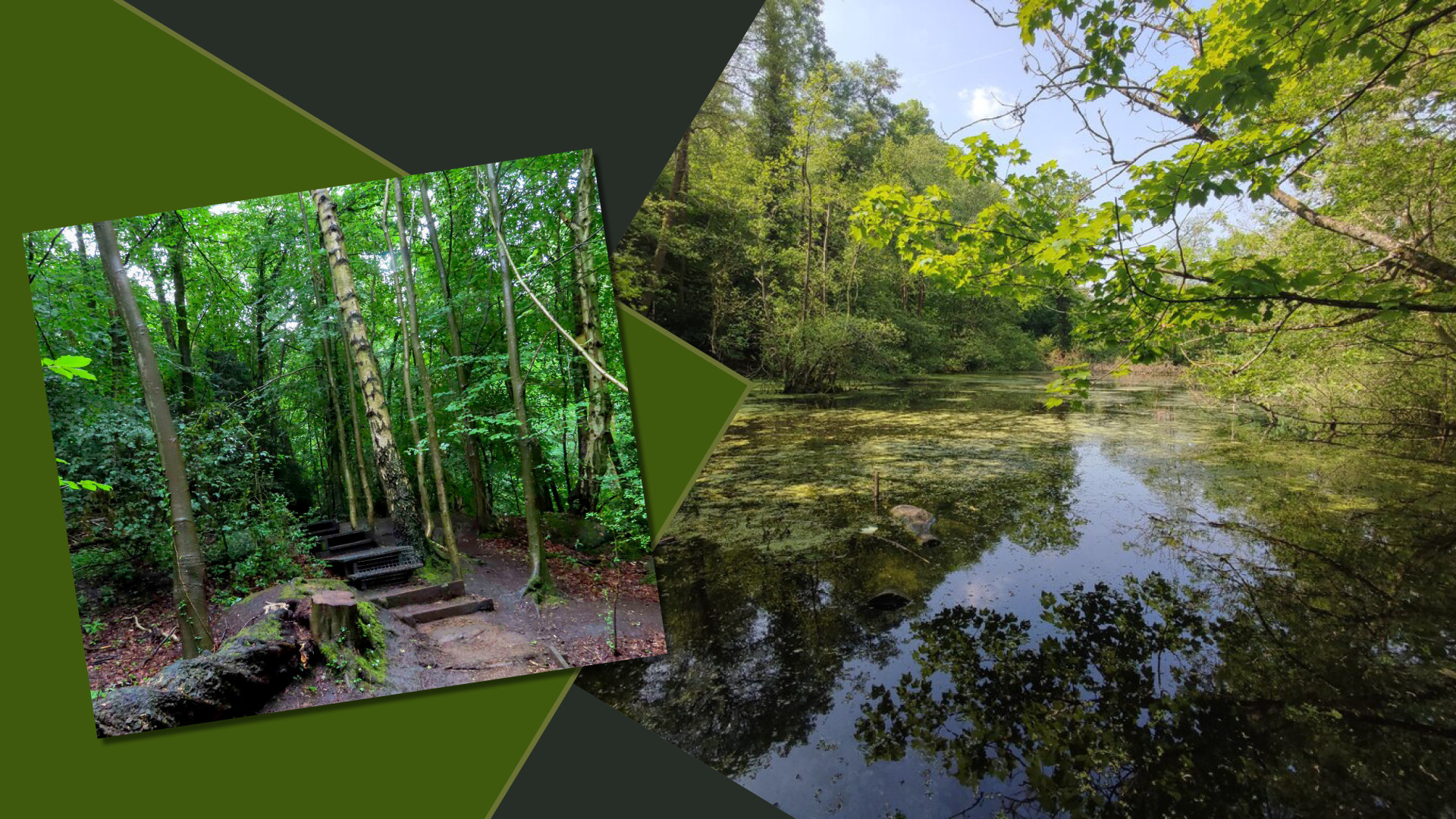
Headington Quarry was home to C S Lewis, and you can visit his house, The Kilns, on the edge of the Quarry area. The house now acts as a residential study centre for scholars rather than a walk-in museum. However, intimate guided tours can be booked which take you through fully restored rooms, including his writing desk, bedroom, and the gardens. Right behind the house is the C S Lewis Nature Reserve, containing the tranquil, flooded clay-pit pond where Lewis used to go walking.
Highlights include:
Cox's Alley & Coppock's Alley: Branching off Gladstone Road are two connected walking alleys. These extremely narrow paths, enclosed by rustic stone garden walls, lead directly down into the hollows of old pits.
Quarry Hollow: A sunken road, once a steep working stone pit (named Blondin's Pit) which is now a quiet area nestled significantly lower than the surrounding modern neighbourhood.
Chapel Alley: This tiny pathway crosses the centre of the Quarry near the former Methodist chapel.
Holy Trinity Church: The church C S Lewis attended for thirty years, where you can view the stunning Narnia Window, an intricately engraved glass window depicting Aslan and images from the Narnia stories. Outside in the peaceful, tree-lined churchyard lies his modest grave, which he shares with his brother, Warren Lewis.
The Six Bells: This quintessential ‘village’ pub has welcomed locals since the early nineteenth century and retains an old-fashioned, working village charm. It has wooden beams, cosy fires, and walls lined with historical photos showing the quarry workers and the famous local Morris dancers.
The C S Lewis Nature Reserve: A large central pond surrounded by a dense canopy of willow, birch and oak trees provides a quiet, shaded sanctuary. Dirt paths wind around the pond and climb the steep, wooded banks of the old pits. Access is completely free and open to the public, although the entrance can be a bit tricky to find, through a small wooden gate just past The Kilns.
Taken together, Old Headington and the Quarry offer the strange pleasure of getting away from Oxford without actually leaving it. Within little more than a mile, Georgian walls give way to sunken quarry paths, Norman stone to Narnian glass, and somewhere between the two, the modern city seems to fall away. Put on a pair of sensible shoes, allow yourself to get a little lost and, for an autumn afternoon at least, let Oxford’s swallowed villages emerge again.