

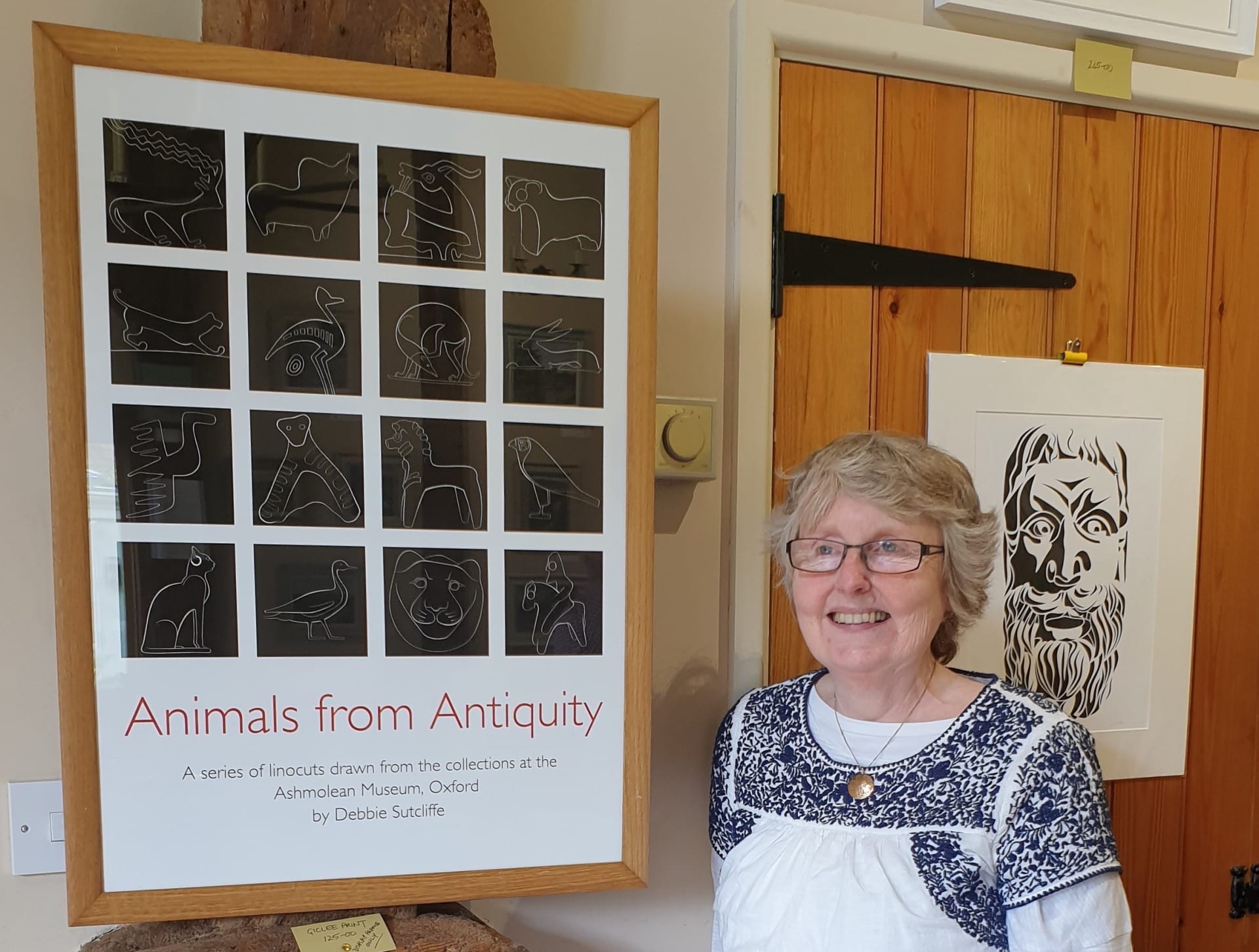

This autumn, a limited-edition hand-printed book by Artweeks artist Deb Sutcliffe, Animals in Antiquity, promises a series of stunning linocuts each derived from sketches of striking sculptures and painted ceramics in the collections of Oxford’s Ashmolean Museum.
“These are not archaeological studies,” says Deb, “but rather a twenty-first-century artist paying homage to those unknown artists working in a previous era. I marvel at their design skills and the simple, uncluttered shapes with beautiful lines. My own way of working was inspired many years ago by the linear purity of ancient rock art and the incised decoration on Greek vases. I moved away from the more tonal work of my youth in favour of a simplified, linear style. When I later became a wood engraver, I developed my style further to show mass by the subtle variation of line weight, letting in degrees of light with the white line.”
It's a technique printmaker Deb now uses, whether working with wood or lino, and her minimalism and focus on the essence of the subject reflect the same brevity of line she sees in her exploration of these ancient objects and her animal motifs.
“Shape and line are everything. Less is invariably more to my mind. In the case of the painted ceramics, I have selected just a detail of the decoration on a pot to focus on, and I imagined the paint fresh, not chipped or faded”.

In addition to Deb’s linocuts, the book also includes an ‘unintended’ conversation, between the artist and Dr John E Stanton, Professor of Social Sciences, and Director of the Berndt Museum of Anthropology at The University of Western Australia, the serendipitous result of their reflections on the work.
“Debbie’s linocuts of works held by the Ashmolean Museum, one of the great museums of the world, suggest to me a significant element of renewal,” he says. “They are a re-appraisal. A re-appreciation. A re-vitalisation.”
And so, while the core of the book is a series of animals depicted with a stunning timeless, simplicity, together Deb and John muse on friendship, on connections between people, however far apart they may be in time or geography and on the past, the present and the future. The book is also an illustration of the way art and contemporary conversation can give museum collections – material manifestations of cultures – a new life and a new significance, keeping the spirit of diverse cultures alive for today and centuries to come.
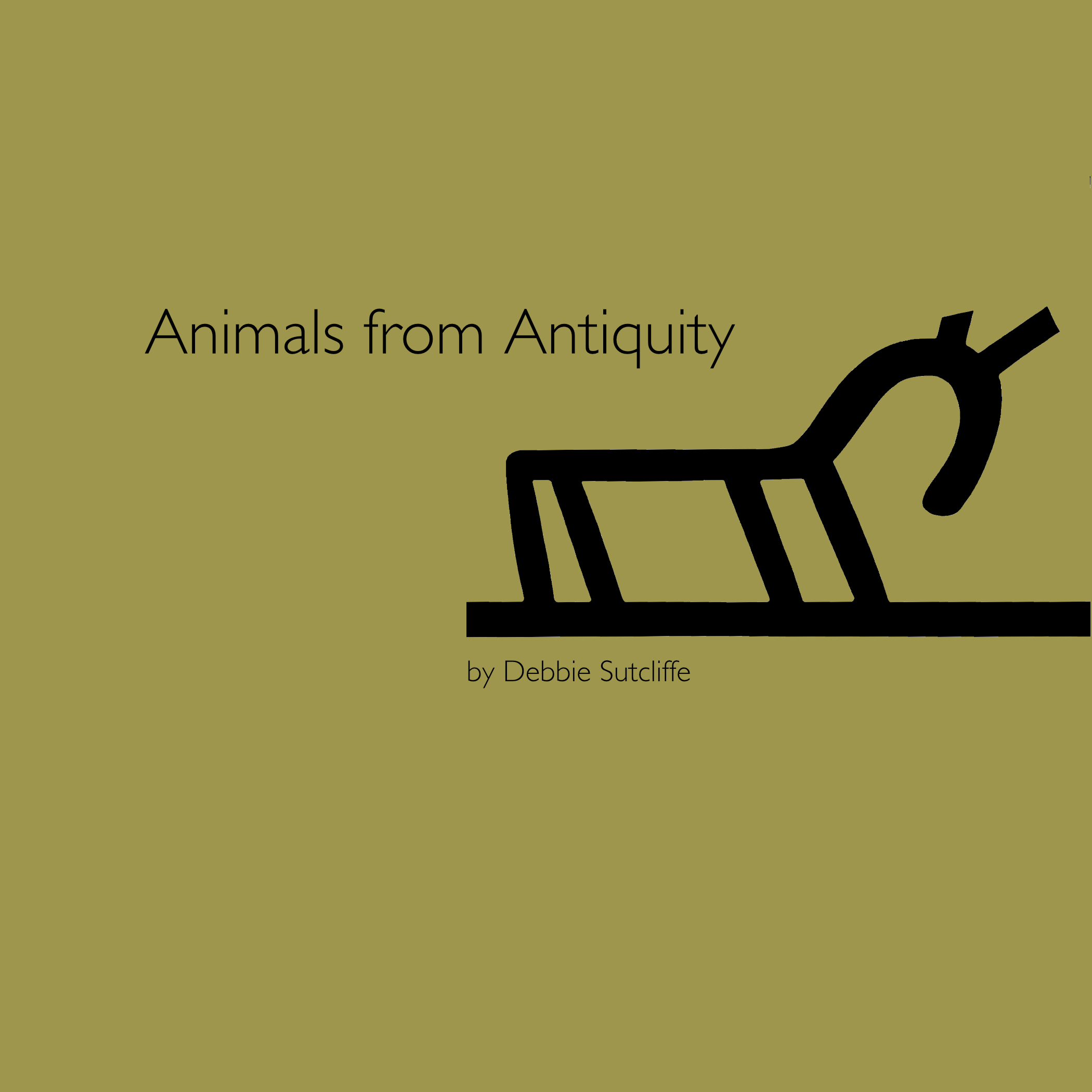
Animals in Antiquity (November 2024; Richard Lawrence Publishing, Hurst Street Studios, Oxford) will include 16 linocuts plus cover/endpaper illustrations.
Limited to 30 copies, this book has been typeset by hand in Monotype Gill Sans Light and Extra Bold and printed on Liber Charta paper using a Heidelberg platen and a Vandercook proof press, and cloth-bound by Green Street Bindery, Oxford. £220. Advance orders are available to OX readers at £180. Simply email info@debbiesutcliffe.co.uk for more information or to order your copy.