

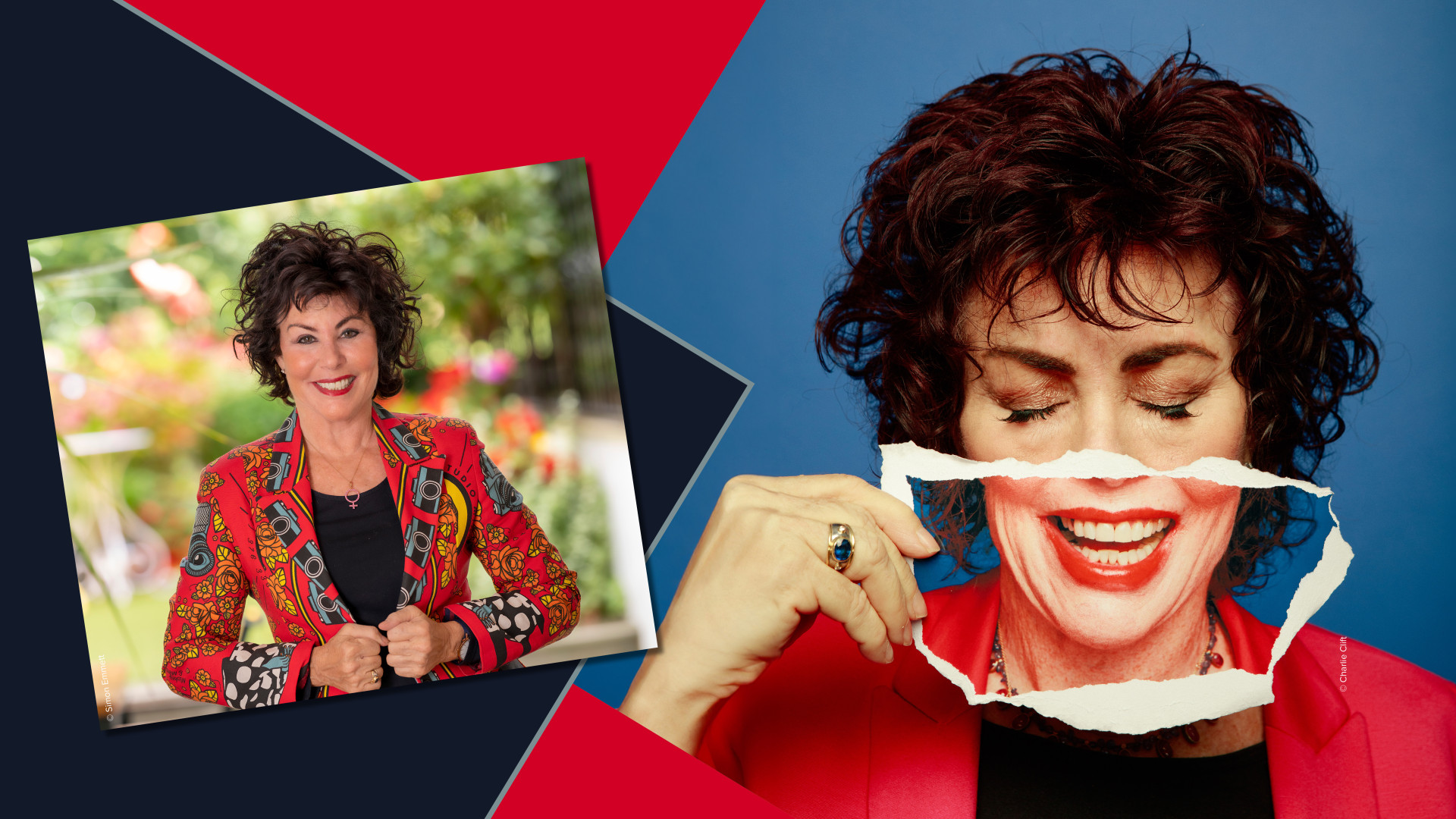

I’m chatting with Ruby Wax over Zoom. She’s in her garden, and I’m at the kitchen table. She’s one of the best, most popular and most entertaining interviewers of all time and I’m… well, I’m in awe.
Ruby started her career as a classical actress, moving to the UK in the 1970s and training at the Royal Scottish Academy of Music and Drama. She spent time in Sheffield with the Crucible Theatre before moving to the Royal Shakespeare Company in 1978. However, it was in the 1980s that she made her mark on the public consciousness, co-starring in the popular sitcom, Girls on Top. Establishing herself as one of the UK’s seminal comedians, she went on to numerous other television roles, including that as script editor for the incomparable Absolutely Fabulous. However, it was her celebrity interviews ,which ran over for almost 20 years, which made her a household name.
Famously open about her own mental health challenges, she founded a mental health website in 2011, and in 2013 published Sane New World, a number one bestseller. This was followed in 2016, with A Mindfulness Guide for the Frazzled after she graduated with a Masters Degree in mindfulness-based cognitive therapy from Kellogg College, Oxford. She has gone on to receive an honorary OBE for her work in the field of mental health and is a passionate and respected campaigner, author and educator on the subject.
In September she will be coming to Oxford twice – once in each of her roles. First at The Oxford Playhouse with Absolutely Famous, a show which lifts the lid on some her most famous television interviews, and then later in the month as a speaker at Transform Trauma 2026, Europe’s largest mental health conference.
Ruby, let’s start with Absolutely Famous. What can you tell us about the show?
Oh, well, we wanted to show sides of things maybe the audience have never seen, but also, we talk about the nature of fame and the addiction of it – who got affected by it and who didn't, and that was sort of my raison d'etre in doing the interviews. I was doing a study on how they were affected, you know? It's like a carbuncle that grows on somebody, and how do they deal with it? It's the elephant in the room.
There were a few that got away with it, but Madonna couldn't get her vision past herself. When it's, let's say Carrie Fisher, it becomes a love affair, and you watch how that happens – how the interview turns into a relationship, and then also there are the disasters, like Trump seeing me for the first time and wanting me dead and off his plane.
It is all about vibes, and how trust is built – and how to keep your mouth shut and let people hang themselves. You know, despots [were] usually not my favourite guests, but the guests wanted to come out and play as humans: they don't want to talk about their latest film, everybody asks them about [that] and says what big fans they are and it sort of embarrasses them. I go underneath all that.
How hard was it to carry that off?
In those days, as long as I was funny, that was how long the interview lasted. That’s why I talk so much in the beginning, because I'm auditioning for them. They say, ‘wait a minute… we have a new creature here, do we want to spend the day with her?’. And then sometimes it's overnight, sometimes it's two days, sometimes it's two weeks. I never had anybody for five minutes.
Not Madonna?
No, not even Madonna. That went on for a couple of hours, but it was a disaster. It’s still watchable because thank God for editing; it looks like she likes me, but she really didn't. I asked stupid questions. We didn't get into a conversation on her level – I don't know what her level was. I tried to be funny [but] when somebody doesn't have a sense of humour, you're going in with a piece of equipment they don't understand.
I like to cross swords with people that are smart. With Pamela Anderson, we could have gone on for days, and we did. I interviewed her a lot because she knew how to play the game: it was called irony. I wasn't really talking to her like she was a ‘babe’. We were joking about the babe situation and how people misinterpret her. She played ball; came out of the closet and just played ball.
Did you have question in your repertoire that would operate as a failsafe icebreaker?
No, I knew about their life. I knew Bette Midler worked in a canning factory, so I wanted to start at the bottom where she was nothing. Then they go down memory lane, and they remember, and then they really get fun, and open up.
When it worked, it felt like I was dancing with them. It was just perfect, and the question would be perfect, and the answer would be perfect, and then you couldn't tell who was talking. Sharon Stone and I skated on ice. She couldn't get out of the hotel room because she thought she would be recognised, so we dressed up as old men, and went to a deli. I gave her the time of her life. She was so happy.
You have so much talent and creativity and ambition. Were you happy to be in the role of interviewer rather than interviewee?
I wanted to be the interviewer – but I talked too much! I think I would have had a longer career if I’d shut up a little bit.
Well, it seems like it’s still going well for you now…
It's going pretty well. Maybe I'd be more of a Louis Theroux if I kept it a little more neutral… On the other hand, people like the wildness, especially a female who doesn’t give a shit. I mean, I was the first female that threw the looks and the image to the wind. I didn't care what I looked like, or if I failed. We showed a failure interview with Bill Cosby, and I didn't mind. It was gruesome, because he tried to put his hands around my neck, and it was a terrible, toxic interview. But we still put it out and I think we showed what people were really about.
Is there anyone you wish you’d spoken with back then, or would want to interview now?
PR is so powerful now, [I] would only get five minutes, and [celebrities] are used to Instagram where they just show, like, a fingernail clipping of themselves. They're so scared of being cancelled, so wouldn't get much out of them. I think there'd be too much paranoia but probably Lady Gaga would be sensational.
I wanted to go for the politicians, but they wouldn't let me do that at the time. I had Arafat and I had Gaddafi (John Simpson lined it up) and the BBC said absolutely no. That would have been my dream, to move sideways into that.
Following on from that, are there any interviews you would have done differently?
I probably would have played Trump a little differently. I wouldn't ask such moronic questions, but when somebody treats you like an idiot, you become an idiot. I wish I’d held my cool a little more and said, ‘tell me about running for the President of the United States’, and took him totally seriously. He wouldn't have thrown me off the plane and I would have gotten a lot more.
On the other hand, once he threw me off the show gets really funny, because I go through the down-under bit of America where there are Trump voters, and you get to see that. Then I met Melania, and you get to see what she's about when she was still happy and free.
How do ‘celebrity’ Ruby Wax and the Ruby Wax who is a visiting professor and was appointed Honorary Officer to the Order of the British Empire (OBE) for services to mental health co-exist in you?
It's a different feeling. To do a celebrity interview, you’ve got to juice yourself up, get ready, at least pretend that you're thrilled to see them, and then break them down.
With the other one, I use a different side of my brain. I was so interested in neuroscience – I don't know where that came from – and I'm fascinated with those people in a more respectful way. Like, I can't wait to hear what comes out of their brains. Celebrities became kind of predictable, unless you're a real smart cookie like Carrie Fisher, and she was a piece of art. A lot of people were just… they had a talent and otherwise they were normal. So, what's to discuss?
Thinking about your work in mental health, you gained your Masters in mindfulness-based cognitive therapy from Oxford back in 2013. Back then, public understanding of mental health was more limited, but I wondered how you felt about the way in which society has now embraced the concept of mindfulness. It’s become very mainstream…
Yeah, it's become a colouring book. When I studied it, I studied it with neuroscience. It’s a brain exercise, not just having your eyes shut and breathing. It's observing when the thoughts have taken over and bringing that into the body, and then that back-and-forth creates a muscle, just the way you get a muscle when you're doing a sit-up.
It’s yoga of the brain, and you can bring it with you, so [if] somebody's shouting at you, you can't suddenly go into downward dog, but you can do certain brain exercises that cool your engines and bring down the cortisol, you know? It's mechanical, it’s what happens when you bring your focus into your body. You develop awareness, attention, impulse control, and that's the privilege of studying the neuroscience of it.
Our society takes something and makes it commercial. The real big boys don't charge for it; you can go and see Jack Kornfield, Tara Brach, John Kabat-Zinn and it's free, but people don't know how to find the real thing anymore. They get bamboozled because genius advertisers know how to capture your attention, and they're money spinners.
When I wrote my book, A Mindfulness Guide for the Frazzled, [I explained that] you can do the exercise of mindfulness at the bus stop, while you're driving with your kids, in the shower, while you're eating. It's an exercise that, if you understand the physiology – that you're building a landscape – it gets easier and easier. If I get a kind of amygdala hijack, I can bring it down faster, and the fact that I can do that means I'm way ahead of the game. I can focus my attention longer than most people, but I'm still screwed up. You know, I still have depression. There's no miracle drug.
Taking into account your own challenges, when you look back over the interviews, there must have been some which coincided with times when you were struggling. Have there been moments that have been painful to watch again?
I didn't like the smiley personality. You know, the gurning, willing-to-please, no matter what was thrown at me. I didn't like that character. On the other hand, it confused them because I kept in there. When I was smart, I asked great questions.
See Ruby Wax in Absolutely Famous at The Oxford Playhouse on Thursday 3 September. For more information and to book tickets visit oxfordplayhouse.com
Ruby will also be speaking at Transform Trauma 2026. More information can be found at mastersevents.com