


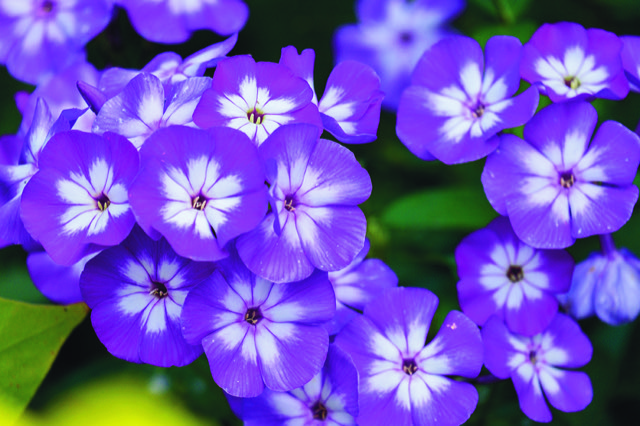

According to nurseryman Karl Foester “a garden without phlox is not only a sheer mistake but a sin against summer”. It is thanks to a Quaker botanist from Philadelphia, John Bartram, that we are able to grow phlox in our gardens in the United Kingdom. He brought the summer flowering Phlox paniculata, often considered a quintessential English cottage garden plant, as well as Phlox subulate (Creeping Phlox) to this country in the 18th century and they have remained popular ever since.
Phlox are a large genus of 67 species, mostly perennials, derived from the Polemoniacaea family which also includes Polemonium (Jacob’s Ladder). Originating from eastern and central United States and eastern Canada, once they crossed the Atlantic, varieties of P paniculata were hybridised by Victor Lemoine, a well-known French plantsman who introduced P paniculata Iris in 1890 and P paniculata Eclaireur in 1892. German horticulturist Wilkhelm II Pfitzer introduced summer flowering P paniculata ‘Europa’ in 1910 and all three are still available.
In the 1880s phlox were popular in the UK as a cut flower. However, they soon became popular garden plants in many late Victorian and Edwardian gardens and were frequently chosen by Gertrude Jekyll in her planting schemes. Many new cultivars were introduced through the early part of the 1900s, many of which continue to remain popular over a century later. Varieties bred by H J Jones in the early 1900s in the UK include a darker eye within the centre of each flower, making these fragrant plants a delight to grow in our summer gardens. German horticulturalist Karl Foerster, known for his introduction of Calamagrostis Karl Foerster (Feather reed grass) also introduced a number of cultivars, demonstrating they are not only suitable for cottage gardens, but can be used in planting schemes incorporating grasses along with other perennials, focusing on low-maintenance gardening with four seasons of interest.
When it comes to choosing which varieties of phlox to use in your garden you have a selection ranging from the low growing alpine Creeping phlox P subulate flowering in early summer to the taller P paniculata (also known as border phlox) which can reach up to 1.5m, flowering in July to late August. As well as being long-flowering, most cultivars are attractive to bees and other pollinators.
If you are looking for a border edging, along the side of a driveway or a rock garden, P subulate (creeping phlox) make an excellent ground cover. They flower for several weeks forming low growing clumps 8cm high by at least 30cm spread. Their scent is often described as sweet and floral, with some varieties having a more pronounced perfume than others. They thrive in full sun and well-drained soil.
If you have a shady spot, consider Phlox divaricata (woodland phlox, also known as wild Sweet William). It is ideal for growing in large clumps in dappled shade at the edge of a border, beneath deciduous trees and along stream banks. One variety is P divaricata Clouds of Perfume, with pale lavender or white flowers and a strong vanilla-clove aroma in early summer.
P paniculata is worth including as a border plant as it flowers from July well into August and, if dead headed correctly, you may get a second flush. Its perfume, which wafts over the garden on a summer’s evening, is an added bonus. Depending on the variety selected, they can grow from a height of 50cm up to 1.5m with a spread of up to 75cm. You will find a wide variety of colours from white such as Mt Fuji, White Flame or White Admiral. Other flower colours range from the palest pink to bright magenta with a range of blues and purples to contrast with other border plants. If you are looking for something with a variegated leaf (which provides interest before they bloom) look out for the less common P paniculata Norah Leigh with white-pink flowers; Harlequin with violet purple flowers; or Goldmine, a tall variety with deep magenta blossom.
Phlox are all generally easy to grow and are frost hardy. They need a moisture resistant but well drained soil so improve with organic matter such as garden compost or well-rotted manure before planting, and then mulch afterwards, too. You must ensure the soil does not dry out, otherwise your plants will experience mildew. P paniculata prefer full sun but will tolerate semi-shade and alpine phlox needs full sun, whereas woodland phlox requires dappled shade. As their stems are sturdy, they rarely need staking unless they are planted in an exposed site. After a period of three to four years, they will need lifting and dividing which should be done early spring or after flowering in September. Replant clumps around 60cm apart. If you don’t opt for cottage garden style planting, these plants look good with grasses for a more contemporary look.
Finally, if your phlox is experiencing stunted growth it may be affected by a microscopic pest, eelworm. Affected plants will also be chlorotic and you will have to destroy any which are. Remember, if this happens to you, phlox should not be replanted in the same area for at least three years.