

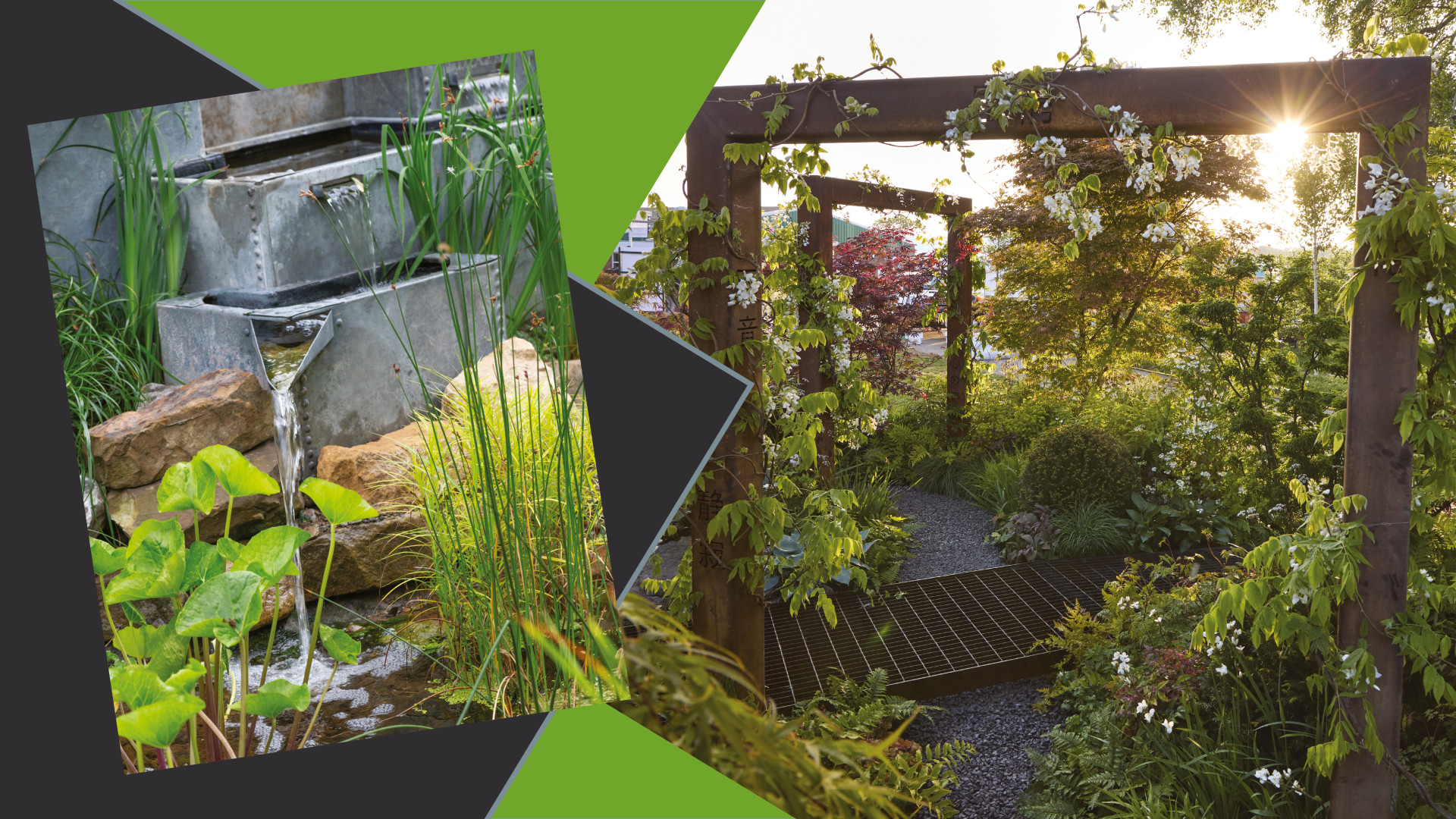

The award-winning Flood Re: The Flood Resilient Garden, first displayed at the RHS Chelsea Flower Show 2024, has now been relocated permanently to Howbery Business Park near Wallingford. This is a particularly fitting venue for it because parts of South Oxfordshire are prone to flooding, and because the park is owned by HR Wallingford, an organisation that helps develop resilient approaches to flooding. The garden design has been adapted to fit into the Howbery Park environment and is open on weekdays free of charge, offering people the chance to enjoy and benefit from this setting.
The garden sponsors, Flood Re, are a joint initiative between the Government and insurers. Their aim is to make the flood cover part of household insurance policies more affordable. To design the garden for the RHS Chelsea Flower Show, Flood Re worked in collaboration with Dr Ed Barsley, who specialises in environmental design, developing strategies to improve the resilience of communities and the built and natural environment, and garden designer, journalist, and author Naomi Slade.
The garden they designed for the Chelsea Flower Show had to be a relatable, enjoyable, and beautiful space whilst helping to reduce flood risk and able to recover quickly after periods of heavy rain. Incorporating thoughtful landscaping and planting, the features included can help to protect homes whilst enhancing the property’s outdoor space. Flooding is a growing issue in the UK, with many parts of South Oxfordshire sustaining flood damage, along with the associated physical and psychological trauma endured by people in the areas affected. This pioneering garden incorporates many ideas, materials and plants which can give people living in a flood-risk area ideas on how they can prevent some of the damage which may occur.
The RHS Chelsea garden was designed with its forever home in Wallingford in mind, for instance incorporating willow trees which can be found elsewhere in the spacious Howbery grounds. However, the space in Oxfordshire is larger than that at Chelsea and is flanked on two sides by the café and an office, so the garden had been scaled up and tailored to suit its permanent site. Ed Barsley designed the reimagined Flood Resilient Garden with landscaping and planting design by Belderbos Landscapes, who built the garden at RHS Chelsea Flower Show. The aim was to create a space for the local community and wildlife to enjoy for many years to come, as well as a place for visitors to learn about making their own gardens flood resilient.
Most of the plants from Chelsea have been incorporated into the new design. As not all the structural elements were suitable for the new space, where possible they were repurposed. For instance, the bridge from Chelsea Flower Show has been made into a large, stepped bench for a patio overlooking the pond, while the Chelsea decking and fencing have been used to create bespoke tables and bench seating for Howbery.
As mentioned, at Howbery, the garden is to be found next to the park’s café, which adjoins the period Manor House with its sweeping lawns, but the designers believe the principles on show there can easily be applied to privately owned gardens. To reduce flood risk, the garden slows and stores rainwater, using hard elements and dense planting. The pergola, redesigned for Howbery, has an integrated gutter that channels rainwater from the surrounding rooftops down and into the garden via rainchains and a series of large reclaimed galvanized tanks. These help to slow the flow of rainwater rushing into the garden and can hold over 10 bathtubs of water which can then be discharged ahead of further rain, using smart technology.
The planting is green and lush, with pops of jewel-colours, yet it is as tough as it is beautiful, and appropriate for the garden’s varying soil conditions and light levels. A large quince tree is set within the garden, while pond and bog plants can adapt to varying degrees of water inundation.
The garden includes ferns to colonise areas which are habitually damp and shady, as well as those that are relatively well-drained. Several species are used, both evergreen and deciduous, to provide lushness and continuity of structure.
One of several plant families chosen for their adaptability within the species and harmonious looks were Ranunculus which are naturally extremely widespread and tend to be tolerant. R acris is an attractive wildflower of meadows and the double form is sterile, while R flammula is a pond plant. Trollius will live on cliff ledges as well as damp meadows and stream-sides, while Caltha palustris will tolerate considerable wet alongside relative summer dryness.
Willows are versatile, attractive, and resilient, and are quite happy in moist ground. In a smaller garden regular pollarding can keep willow compact, but with established roots while the trunk adds vertical interest. Moreover, fresh growth has good winter colour.
While many larger plants within the garden are flood resilient or can tolerate occasional wet feet, attractive filler plants can make a huge difference to the speed at which a flooded garden will bounce back. Annuals and biennials are quick and cheap both to grow and to replace after a flooding event. They can be used to cover the ground rapidly, providing nectar and food for insects, and improving the view.
Find out more at floodre.co.uk/flood-resilient-garden.
The park is open to the public on weekdays but closed on Bank Holidays.