


When an herbaceous plant, shrub or tree receives a commendation from the RHS, you know you are on to a winner. We are highlighting just some of the 2026 finalists, including the Winner of the RHS Plant of the Year 2026. Some available now, others may need to be pre-ordered.
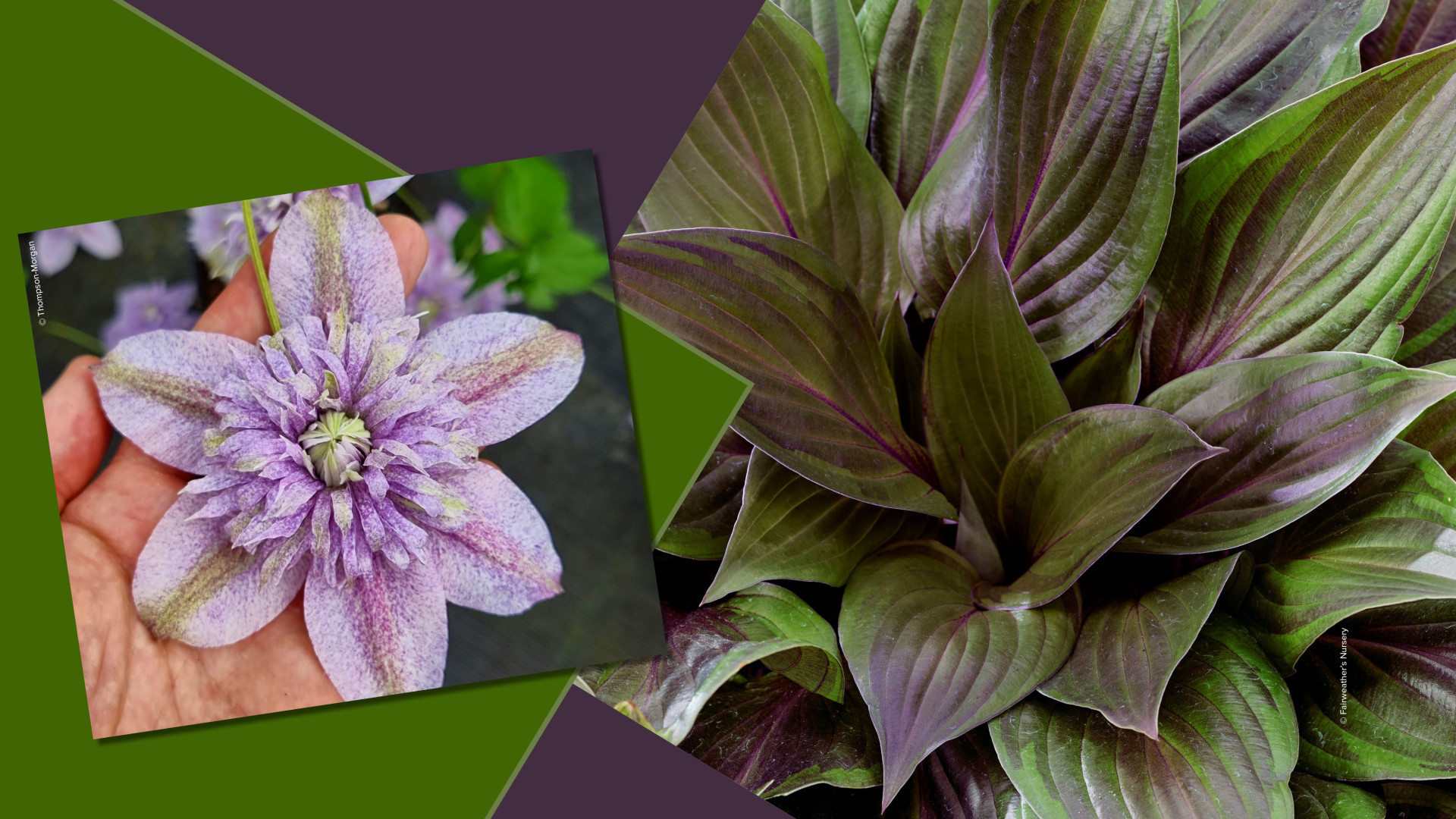
Hosta Red Ninja won this year’s RHS Plant of the Year. This award-winning cultivar was developed by plant breeder Ninja Kramer. A full plant mutation of Hosta First Blush, this new cultivar has leaves which when they emerge in spring have rich, intense red tones, complimented by deep green margins and this colour retains well into summer. Whilst most other Hostas will struggle if planted in sun, this cultivar actually needs some direct sun to get the most from its leaf colourant. Growing to a height of up to 35cm, it is fully hardy down to -23°C. Look out for Hosta Red Ninja as supplies from Fairweather’s Nursery in Brockenhurst start to filter through to garden centres around the country. You can also pre-order from siennahosta.co.uk who used this magnificent Hosta in their display at RHS Chelsea Flower Show 2026.
Clematis Queen’s Nurse is a 2026 Plant of the Year finalist. The renowned clematis breeder Raymond Evison has created a remarkably beautiful free-flowering clematis which produces two distinct bloom styles on a single plant. This compact clematis has striped flowers on young growth and solid-coloured blooms on mature stems providing a changing display through the season. It offers a long flowering period from spring to early summer, with a repeat display in autumn. Named to honour the close relationship between the National Garden Scheme (NGS) and The Queen’s Institute of Community Nursing (QICN), this vibrant clematis marks the origins of the NGS in Guernsey. Founded by Raymond Evison CBE and the Guernsey Queen’s Nurses, the scheme began as a way to raise funds for the Queen’s nursing service. Today, Clematis Queen’s Nurse helps raise awareness of both charities. It can be pre-ordered for delivery in September 2026 at raymondevisonclematis.com.
Pittosporum Green Mound is another finalist. This new hybrid evergreen shrub not only offers great foliage but also architectural form, richly fragrant flowers which fade from white to soft yellow, and is it reliably hardy. This hybrid cross was created by breeder Frédéric Julien whose goal was to produce a pittosporum suitable for Northern European climates. He did this by crossing Pittosporum tobira with Pittosporum heterophyllum. It has good drought resistance once established, and can be planted in full sun to light shade.
Prunus Sumaura Fugenzo was described by the RHS as ‘the cherry tree that stops you in your track.’ A striking Sakura cherry its exceptionally full, frilled blossoms appear like miniature Japanese paper lanterns. The petals begin in shades of white, pink and green gradually deepening in colour as the flowers mature, adding depth and movement to the display. Flowering coincides with the emergence of young coppery foliage, which matures to green through summer before turning rich orange in autumn, thus ensuring interest well beyond the spring display. This tree is medium sized with a spreading habit best planted in a sunny or lightly shaded position. Along with many other types of ornamental trees, this flowering cherry is available from award-winning Frank P Matthews who are based in Worcestershire, frankpmatthews.com.
Antirrhinum Shiryu Kiss – another finalist cultivated by Peter Moore from bredbypetermoore.co.uk. Whilst many Antirrhinums are grown as annuals, this is a true perennial combining exceptional flowering performance with true perennial reliability. It also has strong resistance to rust and powdery mildew. Peter has bred this cultivar from a 2015 cross between Antirrhinum glutinosum and Antirrhinum Dwarf Purple. Its name, Shiryu Kiss, draws from the Japanese word for purple dragon, symbolising strength, beauty and good fortune. It is highly attractive to bumblebees and butterflies with its rich purple, nectar-rich flowers. Sales of this plant also support a meaningful cause with 100% of royalties from plant sales donated to Perennial, the horticultural charity supporting those in the industry.
Clematis Minamo-no-Yousei, also known as Clematis Mochi deserves to be a finalist. Tetsuya Hirota has created a plant which offers a completely new visual effect. Its flowers open initially as single blooms, then gradually develop through semi-double to fully double blooms, creating interest over an average 120 day flowering period. With its compact habit, this Clematis is ideal for container and small gardens. You can buy it from thompson-morgan.com.
Euphorbia × martini Walberton’s Little Treasure® certainly deserves to be a finalist, as this perennial represents a breakthrough in plant breeding introducing the first all-yellow foliage form of this popular evergreen species. Discovered at Walberton Nursery in West Sussex as a single branch sport of Euphorbia x martini Tiny Tim, it immediately stood out as something entirely new and exciting. What makes Little Treasure® especially charming is its dynamic, seasonally changing foliage. Bright yellow in early spring, the leaves soften to a green-yellow in summer, before returning to vivid yellow in autumn, when the tips are also flushed with warm rusty-orange tones. This evolving colour display provides interest across much of the year. Growing to around 30 to 40 cm in height and width, it is suitable for borders or containers in sun or light shade in well-drained soil. It does exude sap when being pruned so essential to wear gloves when handling. Ideal for combining with contrasting plants such as ornamental grasses and dark-leaved Heuchera. This wonderful Euphorbia is available from a number of suppliers, both garden centres and online.
Rosa Amirose, a beautiful rose with peach-coloured buds which open to reveal fragrant pink flowers with purple centres, and also drought-tolerant and disease-resistant. It has been developed through a long-term breeding programme by Thomas Proll and offers a compact ground cover form of Rosa persica growing to a height of 40cm by a spread of 50cm. Thrives in full sun to partial shade and is ideal for covering bare spots or growing in pots. Available from a number of online suppliers including hillier.co.uk.
Streptocarpus Sirius is a great house plant if you are looking for an early flowering Streptocarpus (Cape primrose). Bred by Lynne Dibley from award-winning Dibleys Nurseries (dibleys-shop.com) Sirius is a fully double variety with big, inky purple flowers with deep purple veins over a pale yellow base. It blooms early, is fast growing and will provide flowers from February to December. This Streptocarpus thrives in bright, indirect sunlight. Best watered from the bottom to ensure compost is lightly moist but not waterlogged and to avoid getting the leaves wet. Good drainage is essential to support healthy roots, and it should be fed with liquid seaweed during the growing season to encourage flowers. Deadhead once blooms go over.