
As Bellowhead prepare to celebrate their debut album’s 20th anniversary, Jon Boden talks freedom, theatricality and the strange mix of sadness and joy that keeps the band playing.
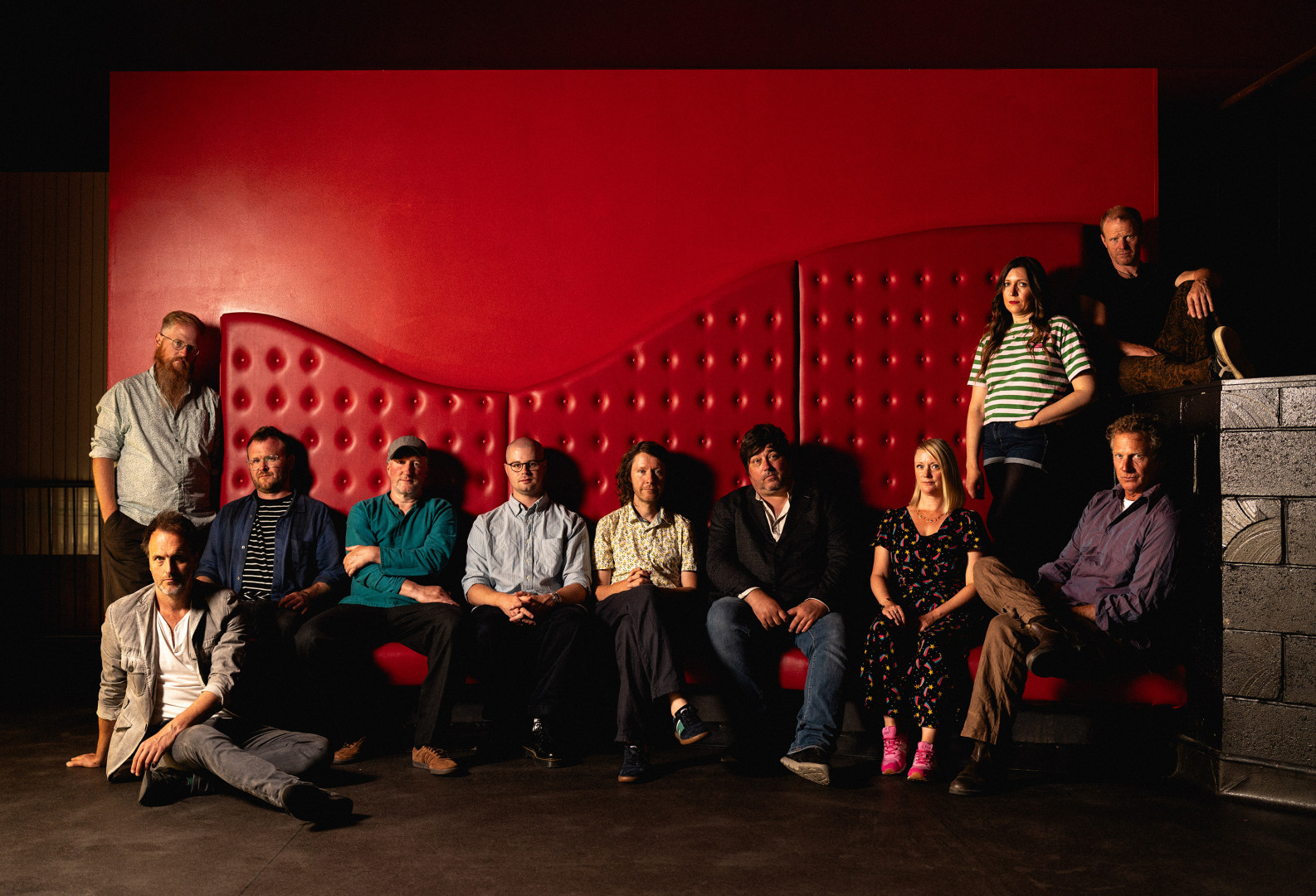
Bellowhead are a curiously named, theatrical and larger-than-life 11-piece big-band folk setup. Spawned from the folk duo of Jon Boden and John Spiers, this ambitious project had inauspicious beginnings back in 2004, when they dreamt it up whilst stuck in a traffic jam on the M25.
With a vaudeville vibe and circus-ring energy, they first played at the Oxford Folk Festival and built an incredibly strong live reputation by touring heavily before releasing their debut album, Burlesque, in September 2006.
Combining traditional English folk with raucous brass and dramatic vocals, the album’s title was considered an apt description for the grand, tongue-in-cheek spectacle of their ensemble. With disparate global influences from Napoleonic-era ballads and Brazilian sea shanties to the American minstrel tradition, Bellowhead succeeded in creating a colourful, exaggerated variety-show aesthetic.
After years of extensive live playing and a whopping five studio albums, Bellowhead shockingly disbanded in 2016 following Jon Boden’s decision to step down as frontman and lead singer. The remaining members decided they just did not want to continue without him. Even so, the band launched a massive farewell tour, which concluded on May Day 2016 at Oxford Town Hall – the very venue where they had played their first show 12 years earlier.
What was meant to be a permanent ending shifted during the pandemic. To pass the time during lockdown and mark the 10th anniversary of their hit album Hedonism, the band members remotely recorded a track together. This led to a one-off, highly successful livestreamed reunion concert in December 2020.
Driven by the overwhelming response from fans, the band decided to get back on the road. They launched a full UK reunion tour in November 2022.
However, their reunion was marked by tragedy. Just weeks before the start, founding member and fiddle and oboe player Paul Sartin suddenly passed away. The band made the difficult decision to push forward with the tour, using the performances to pay tribute to his memory each night.
This year marks 20 years since the release of their brilliant debut Burlesque, so I caught up with Jon Boden, the Bellowhead ringmaster himself, ahead of their forthcoming anniversary tour.
You’ve had such a long collaboration with John Spiers. How did you meet?
At a pub called The Elm Tree in Oxford. I was doing some music for a student production there. I’d heard there was a good session there, so I went along and this guy was playing the melodeon in a way I’d not heard before. I’d been singing and playing tunes on the fiddle, so we exchanged numbers and met up. We were both gigging independently at folk clubs – Cambridge for John and Lewes for me. We decided to get together for these dates and we just gelled. John’s thing was playing English folk dance tunes; my thing was singing mostly Irish stuff. So, it took us a while to learn each other’s approach, but it came together.
First you were a duo, and then you became Bellowhead as a band with other players. What significance does the word ‘bellow’ have for you?
When we started as a duo, we were doing mostly unamplified folk clubs. John plays quite loudly anyway, so I had to sing really loud to be louder than his melodeon. So, yes, it’s a joint reference to his melodeon bellows, but also to me singing loudly. Although that’s become less of a thing since we’ve been amplified as a band.
So, Bellowhead – 11 band members! Noddy Holder of Slade reputedly said of Dexys Midnight Runners that with so many in the band, they’d never make any money. What I’m wondering is, is having so many band members in Bellowhead a bit of a logistical nightmare?
It certainly used to be – because you’d be offered a festival and half the band would have other stuff on, and we’re all in different bands. Rehearsals were certainly difficult to arrange. Then we were on hiatus for a few years. In lockdown, we got back together. Since then, it’s actually been logistically a lot easier because we only do a tour every two years. We know well in advance, so everyone can block the time out.
In some ways you’re the darlings of the English folk revival, but some of your songs, like New York Girls and Roll the Woodpile Down, have an American Southern folk, almost Cajun, vibe to them…
That’s true of Roll the Woodpile Down, but with New York Girls, although it was collected in England, it’s actually a sea shanty, so it has a kind of global influence. English folk music includes so many sea shanties alongside homegrown songs because England was a seafaring nation. The British Royal Navy and merchant navy were a huge part of working-class life in the 18th and early 19th centuries, the time most traditional English folk songs are from. Being press-ganged into the navy was a common experience, and great national heroes tended to be naval ones. These shanties were about a relationship to the sea but also designed to help get through the hard work involved on ships. It’s why they are so catchy and got passed around back in the villages and towns that sailors came from – because they were catchy and fun to sing.
I do a song about a pirate called Captain Ward, an incredible character who set up his own kingdom in the Mediterranean, converted to Islam and was always getting one over on the King. It’s heroic but has an outlaw quality to it.
Do you think folk music has a place within the outlaw tradition of rule-breaking?
It’s not so much about breaking rules as a desire for freedom. Many folk songs celebrate a nomadic existence and act as wishful fulfilment for people stuck in a rigid social hierarchy. Songs celebrating beggar life, for example — an awful existence in reality, but they were about being able to tell the boss where to go, head off with a backpack and disappear – seduce a lady of the local manor or whatever…
It’s the 20th anniversary of Burlesque, which is why you’re embarking on your latest tour. The word has roots in mockery and satire but also evokes erotic tease. That can be empowering for women, though critics argue it can reinforce the male gaze. Did the title give you pause then, and do you see it differently 20 years on?
It’s not something we thought about at the time. I remember feeling nervous about having a female model on the cover. Perhaps it should be thought about a bit differently now. We just saw it as being about parody and satire and still do. Ultimately, the idea behind naming the album Burlesque tied it to the cabaret feel of Weimar Germany. A Brecht and Baalvibe.
That’s an interesting connection because you’ve been described as having a ringmaster energy when you perform. Do you feel this description fits, and is it still a fair analogy?
I love being lead singer. For me, one of the big factors when forming Bellowhead was that I just felt I could do it. I knew no one was ever going to ask me to do it, so it had to be a band that I put together. I’m quite an introverted person, really. I don’t like putting myself forward in social situations, but I like showing off on stage. Bellowhead is complete permission to be a massive show-off. Weirdly, it’s a safe place, being on stage, and I love putting on a show.
I started off wanting to go into musical theatre, so I always approach a show from how it will work for the audience. I love the theatricality of it. However, the only thing I’m nervous of is being seen as the ringmaster, because it implies that I’m in charge, and after all this time doing this, the one thing I know is that I am absolutely not in charge.
Yes, because with so many virtuoso members of the band, how do you allow them all their moment in the spotlight?
That has a lot to do with the musical arrangements, which are mostly polyphonic in form – everyone is actually playing something interesting most of the time. Not just plain chords – everyone’s kind of got their own interesting lines which interlink, because we write it all out like a classical composition. It’s quite a difficult thing to work out, but when you’re on stage and this synchronicity happens, it’s great fun. We’re so happy to be there and the audience is so happy to be there. It’s just a really joyous experience.
When we lost two of our members – Paul Sartin in 2022, and Ed Neuhauser more recently, last December – we thought it would be difficult and sad to continue, but it turned out to be cathartic, a strange mix of sadness yet even greater joy.
Bellowhead are touring through November and December and will be playing at New Theatre Oxford on 30 November 2026. For more information and to book tickets, visit bellowhead.co.uk.
Banner image: (C) Sandy Butler