


For 200 years Broughton Grange near Banbury was the home of the Morrell family. When the present owner, Sir Stephen Hester, purchased what was once a small 17th century farm cottage in 1992, he began the transformation of the 400-acre estate, including developing 130 acres of gardens and arboretum. Sir Stephen took inspiration from the gardens surrounding Chateau Villandry in the Loire Valley and, since 1992, together with his head gardener Andrew Woodall and award-winning garden designer Tom Stuart-Smith, he has gone on to establish a truly magnificent and highly acclaimed contemporary garden. Their work resulted in the garden winning the European Garden Heritage Network Award for the Best Development of an Historic Park or Garden in 2018.
Broughton Grange Gardens is a place where texture and form of planting take precedence: expect to be astounded by the planting schemes on offer. Whilst exploring the various areas of Broughton Grange Gardens you may need to remind yourself that most of the construction and development of the area only started in 1998, when the formal Parterre was laid out. The Parterre and Rose Garden was extended in 2018 and 2019 and now runs westward to link in with the Fountain Garden, and all follow the same planting pattern as the original. White, blue and pink colour themed borders containing various David Austin roses alternating along each side of the garden are a sight to behold in the summer. The various compartments are also planted with seasonal planting schemes adding to the area’s visual appeal.
With a vision to connect the garden’s features with the surrounding countryside, Sir Stephen wanted to transform what had previously been paddocks and fields into a garden offering a variety of vistas and areas of interest. Working with Tom Stuart-Smith the designer was engaged to design a centrepiece walled garden with three south-facing terraces using the three-metre fall in the ground that ran the length of the garden. What is extraordinary, however, is this sixty-metre square garden only has walls on two sides: the garden has a strong formal structure conceived entirely in relation to the surrounding landscape and the views to distant tree clumps, hills, valleys and vistas.
In the warmest part of the garden at the Top Terrace, a greenhouse nestles in a corner of the walls, surrounded by a tapestry of Mediterranean flowers, grasses and slender yews. From here a stone rill carries water down to a large stone tank in the centre of the Middle Terrace. Here Tom’s design creates diagonal perspective to the space leading your eyes across to the countryside beyond.
Two sizeable tunnels of clipped beech provide a green, shady boundary which turns coppery brown in autumn. These run along the eastern side of the top and lower terraces, partly concealing and framing vistas beyond. The original west wall is largely hidden, with three pleached lime squares framing doorways into each of the terrace gardens. Planting in the middle terrace comes alive in June when lime green euphorbias, purple salvias and sky blue amsonias vie for attention. Sixteen carefully clipped beech cylinders, each topped with a dome, rise from the beds appearing like a scattered crowd of people viewed from behind.
The Lower Terrace places a 21st century twist on a traditional Parterre with a design based on the microscopic leaf structure of native beech (Fagus sylvatica), ash (Fraxinus excelsior) and oak (Quercus robur). The compartments in this area are planted seasonally, with approximately 5,000 tulips in flower in spring, followed by colourful displays of summer bedding. Against the southern wall is a late summer border planted with complementary perennials.
Other notable areas within the gardens are the Paddock Walk created in 2002, which has a light woodland feel. This is bounded by a former pony paddock transformed into a wild flower meadow. You will also see the ‘dinosaur’ Wollemi pine (Wollemia nobilis) – a tree only known through fossil records until discovered growing in Wollemi National Park, New South Wales in 1994. This particular specimen was planted by Tony Kirkham in 2006 and featured in his television documentary series The Trees that made Britain.
The Spring Walk winds down much of the length of the gardens, providing a variety of features offering seasonal interest. It stretches from the main drive to the Woodland Terrace Garden and if you visit in April, you will experience a stunning selection of spring flowering bulbs, Hellebores, Euphorbias and Camassia. This walk takes you through the Mediterranean terrace below the orchard where you will find the entrance to the arboretum.
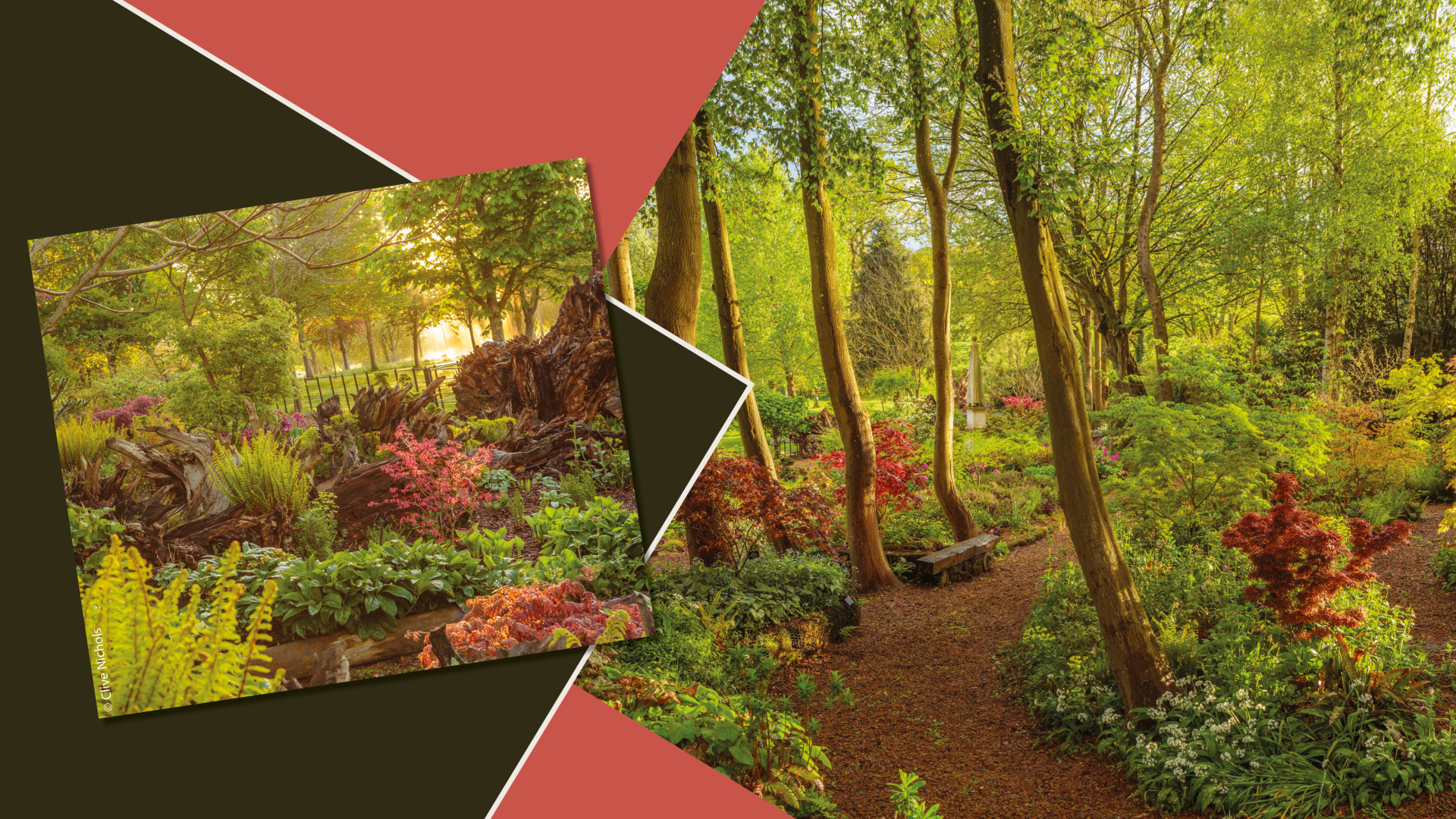
Other interesting elements to explore at Broughton Grange Gardens include a Stumpery, Bamboo Garden, Knot Garden, Long Borders, Water Meadow and the 80-acre Arboretum, one of the largest such recent plantings in the UK with a total of around 2,000 specimen trees planted since 2003. Trees with good autumn colour feature on the eastern side of the Arboretum whilst those offering spring blossom are more concentrated on the western side, nearer the main gardens.
There are three bookable National Garden Scheme Open Days in April, June and July (ngs.org.uk). For further information on other times to visit, go to broughtongrange.com.