


Oxford artist Usha Kar’s paintings Fragments from my Other Life explore, through imagination, layered memories and magical realism, the juxtaposition of a life lived and a life imagined, through the eyes of a child. Esther Lafferty spoke to her to discover more about how her art creates animistic, mythic spaces where beauty and unease coexist, and where questions of identity, belonging, resilience and justice extend beyond the human world.
“In the mid-50s my father arrived to London on a boat from India. He met and married my mother, then a young woman from North Norfolk. It was the days of ‘no dogs, no blacks, no Irish’ but they secured a flat to rent in London where, on a rainy July day I was delivered onto a pink candlewick bedspread. I was their second baby, and shortly after my birth, my distant grandmother asked my parents to send me to her, in India, so she could raise me herself. Instead, I grew up in the margins of London. Occasionally I wondered, how would my life have been, if my mother had put her baby on a boat, to travel to India?”
Instead, Usha’s cousin Uma, her Indian aunt’s first baby, was brought up by their grandmother, perhaps living the life that Usha might have had if she had been sent there. “Although the grandmother I never met was a diminutive woman physically, she loomed large in our lives as a far-away presence,” says Usha, and her importance in the family is captured in a painting, Aaji’s Sari which shows a woman wrapped in a sari, her presence large, filling the garment, yet her physical body absent.
Aged 6 or 7, Usha imagined life in India, writing innocently how she wished to go to India on an ocean liner and tame a lion and an elephant. At the same time, she sometimes struggled to feel proud of her Indian heritage in the days of Enoch Powell. This is depicted starkly in one of her works in which her child’s handwriting is centred amidst local newspaper headlines from that era, such as an article about the representative of a local club stating: ‘We just want to keep it white’.
Some paintings derive from the few stories that her dad shared about his life in India. “He told us that his father was killed by a tiger, so I grew up terrified of tigers – in Walthamstow. It was only when I went to India, I discovered he actually died of typhoid,” she recalls.
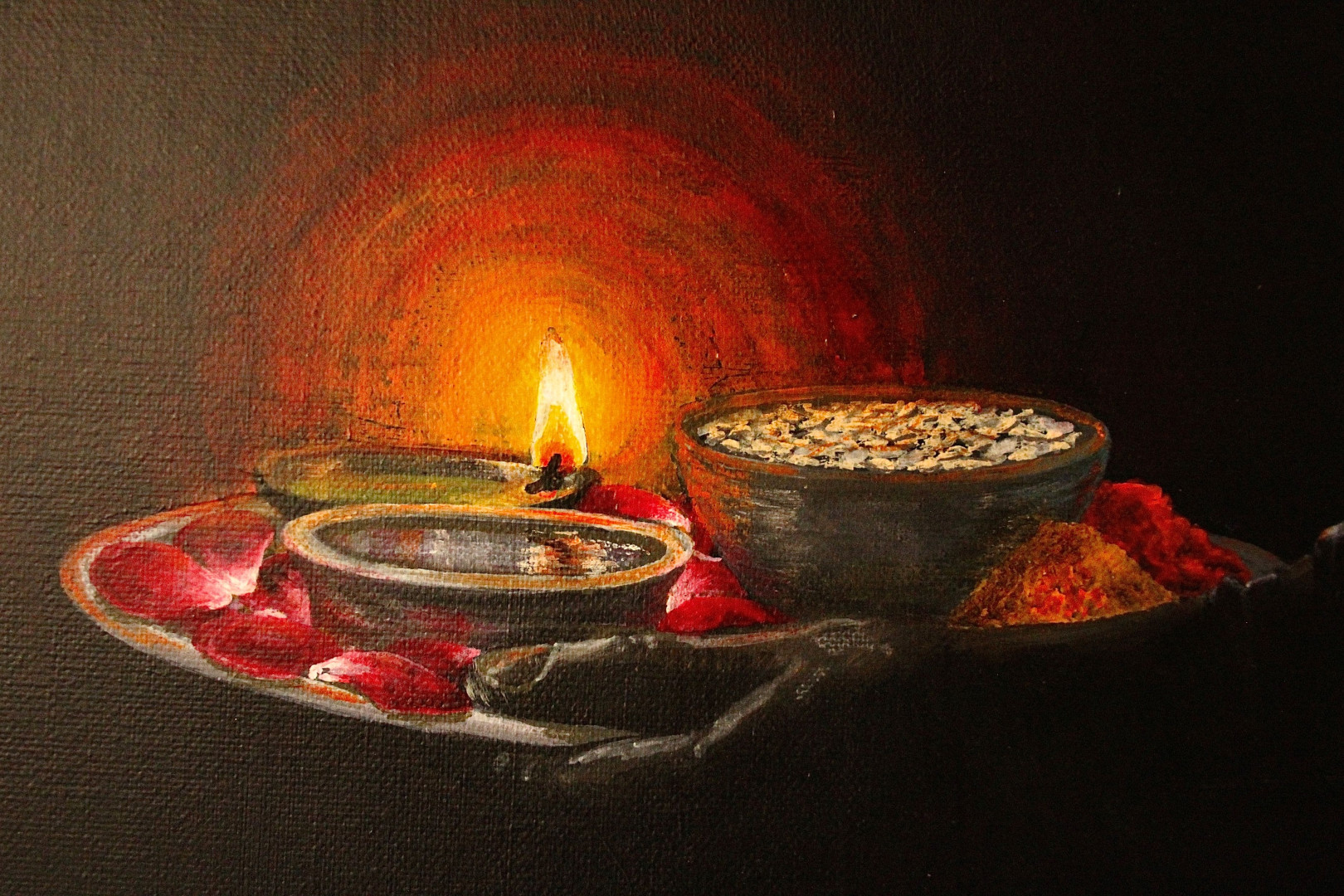
Usha’s father also told stories of Diwali when, as a small boy, he saw special sweets – ‘prasad’ – offered to the gods. “They were blessed and then distributed to the community so my dad and his friends drew up a schedule of when the offerings would be handed out, so they could run from temple to temple to maximise what they could get.”
As a child, Usha couldn’t imagine how those temples looked, so in her work referencing this story she represents them through a sense of divine light. The viewer stands as the child, with a stash of sweets, awaiting the next distribution by a temple assistant whose burdened figure evokes a reminiscent time of devadasis, female artists who lived in the temples having dedicated themselves to the worship and service of the deity for the rest of their lives.
“I first went to India when I was about 30 and it was an incredible time. The visible contrast between wealth and poverty was even starker then than it is today and as the plane descended to land in Bombay, there were people living in shanties right along the edges of the runway. The hot heavy air struck you immediately, as did the smells including the potent overpowering smell of jasmine at the flower market, massive traffic which has its own logic and included magical horse-drawn silver chariots carting tourists around the sights. It felt familiar: when I saw the red soil in the region of my heritage, I had a strong sense of home.
I didn't meet my Indian family, however, until I was 40. They live in the centre of India – if you drew a line from Mumbai to Kolkata, it would be roughly in the middle, close to a city called Nagpur, which is now quite large but would have been a small provincial place when my dad grew up there. His death was sudden and premature, leaving so many unasked and unanswered questions: I was 20, and many details of his life remain a mystery.
Usha’s paintings include a depiction of a giant glowing bindi – for her today a powerful symbol, a tiny portal bridging the gap between her imagination and the grounded version of India. Other works explore contemporary rituals of Hindu culture such as arranged marriage and Shradh the offering of favourite food to the crows on the anniversary of a death, and Adivasi art informed by the beliefs and experiences of India’s former forest dwellers.
Part-triggered by thoughts that stretched beyond the sea from an early age, perhaps, and partly because her parents were anti-racist activists in the 60s and 70s who instilled her with the value of humanity, Usha had forged a career in international development. Whilst working for Oxfam, she travelled to East India and found she needed to visit their Nagpur office. “It was the closest place I had come to my ancestral paternal roots. I had no contact details for my family other than my uncle's surname. Nonetheless, the Oxfam Nagpur office was able to connect us and when I arrived at the airport, two of my cousins were waiting for me with warm smiling faces I could finally pair with names”.
Usha’s paintings are also inspired by photos of her Indian family today and in the past including one very old photo, showing her grandmother and three of her female cousins sitting together on the floor around a ‘family’ of pots. The animistic concepts that inform Usha’s work are evident; she conjures life in the pots, an equivalence between humans and surrounding objects.
“The pots are so important to a family. I imagine them having a life when the humans aren't there,” she smiles, and it’s interesting that one of her treasured possessions is a simple metal plate with her grandmother's name engraved roughly in the back, that has now traced the path her father took, from India to the UK.
“I was so touched when my Cousin Uma gave it to me telling me our grandmother used it every morning for her breakfast. She said ‘Usha, I had her all my life, please, you take the plate.’ When I hold it, it still gives me goosebumps”.
Image: (c) Usha Kar, detail from The Honouring