

Located just between Faringdon and Lechlade, you will find Buscot Park, which has been under the ownership of the National Trust since it was bequeathed to the charity in 1956 by Ernest Cook. Whilst the estate is owned by the Trust, the current Lord Faringdon and his family lease the property, administering both the house and grounds.
The gardens, dating back to the 18th century, cover over 20 acres and need time to explore. They have a number of interesting features including a famous Italianate water garden designed by Harold Peto, the Four Seasons walled garden, the extensively restored Peter Coats Borders originally created in 1986, and the glorious Woodland Avenues and lakes.
Buscot’s original mansion and park was built between 1780 and 1783, for Edward Loveden, whose family had acquired the land some 200 years before. Loveden was extremely wealthy and built a large mansion in the Palladian style. After his death in 1822, papers refer to the debts of the estate and to the fact that much of the additional land acquired between 1786 and 1792 was mortgaged. This continued to be the position as Buscot passed to Loveden’s son, Pryse in 1822; to his grandson Pryse Loveden in 1849 and to his great-grandson, Sir Pryse Pryse, first baronet, in 1855. The latter’s main interests were in the Pryse estates in Wales, and in 1859 he put the Buscot estate on the market.
When an Australian tycoon Robert Tertius Campbell bought the property he made major improvements to the estate, turning Buscot into a highly industrialised farm. When he died in 1887, he, too, left the estate heavily in debt.
In 1889 the property was bought by an exceptionally talented financier Alexander Henderson, who later became the first Baron Faringdon. At this time, the great gardens of Renaissance Italy were exerting influence on garden designers of the day. Keen to implement such designs at Buscot, Henderson commissioned the Edwardian designer Harold Peto to design the formal Italianate water garden which connects the woodland area to the house.
In his day, Peto was a leading exponent of formal Italianate garden design. The Buscot Water Garden was initially built in 1904 and extended between 1911 and 1913. This magnificent garden creates an important link between the house and the Big Lake which was an original feature of the 18th century parkland landscape. Combining his architectural and landscaping skills, Peto’s design consisted of a chain of stairways, paths, and basins, with a central stone-edged canal following the bold linear axis of an earlier Victorian arboretum. His design incorporated a series of enclosed lawns, with effectively placed Italian marble seats and statuary.
The canal stream is made to perform every possible manoeuvre before it reaches the lake, running over narrow rills and miniature cascades and beneath a hump-backed balustraded bridge. At one point the water is thrown into the air by the charmingly playful Dolphin and Putti bronze fountain, a design based on a Greek original. Waterlilies decorate the surface, and box hedges are flanked by stone figures on columns, and herms portraying Roman gods. Where it meets the lake, the vista continues eastwards to the domed and columned garden temple, also designed by Peto, which sits on the opposite shore.
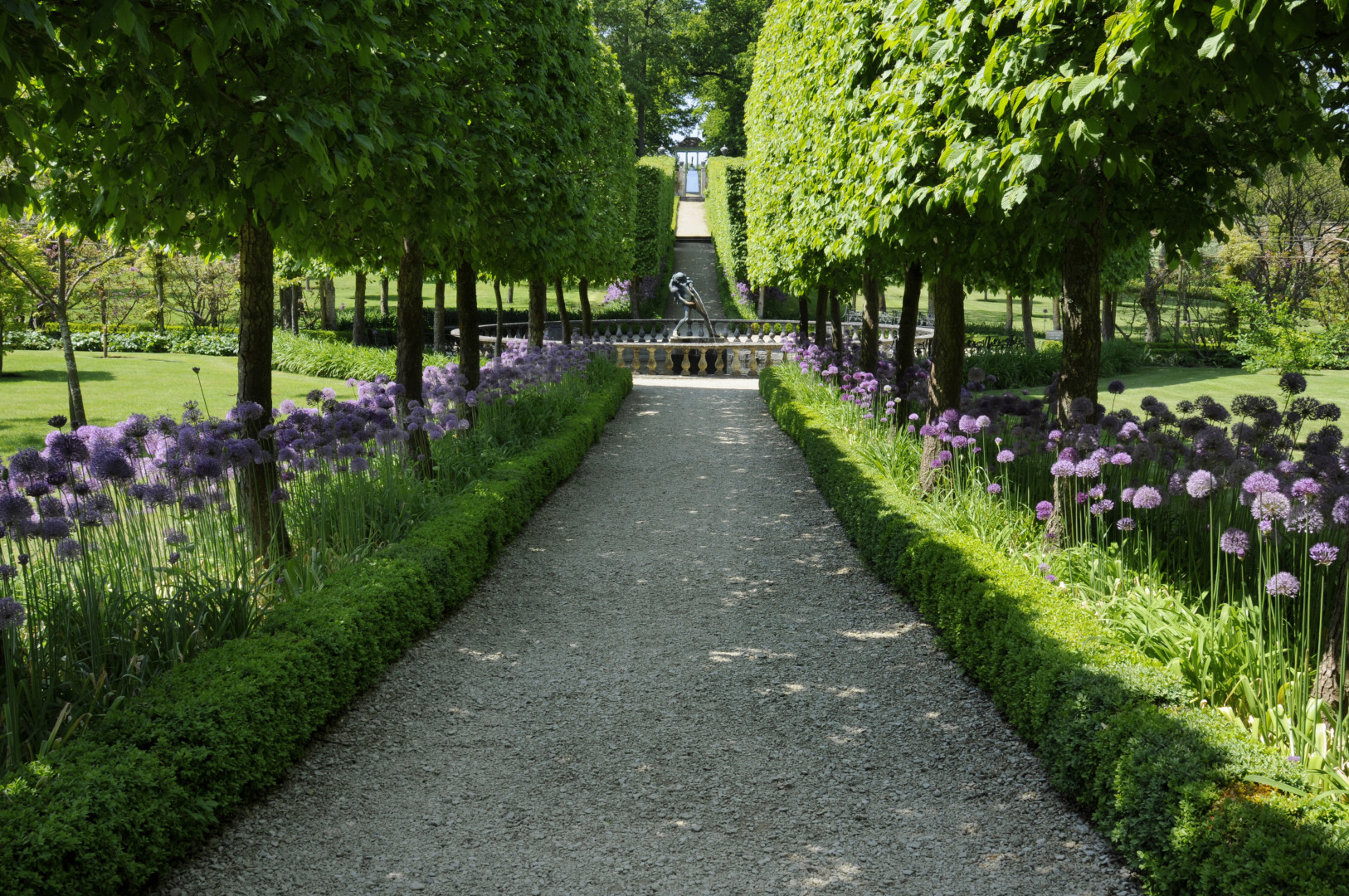
Over the decades since inheriting Buscot Park in 1977, the present Lord and Lady Faringdon have continued to curate the gardens. They have been responsible for transforming a grand but mostly redundant 18th century kitchen garden into a fine ornamental garden which retains a degree of informality. Known as the Four Seasons Walled Garden, the area is divided into four quadrants by two main axis paths with a dramatic vista created with pleached hop hornbeams planted along the longer north–south axis, and pink and white June flowering Judas trees and a magnificent wisteria trained over iron arbour tunnels along the shorter east–west axis. There is a central lily pond with a fountain, statue and handsome balustrade.
Appropriately, this part of the garden also features statues of the Four Seasons, created by Frank Forster who was the winner of a 1982 competition promoted by the Faringdon Collection Trustees and the President of the Royal Academy.
A number of trees and shrubs have been carefully selected to give colour throughout the year. The perimeter borders contain spring bulbs and various herbaceous perennials but are at their best in June when the fine collection of old French roses, mixed in with more modern cultivars, come into fragrant bloom. Between the climbing roses, fruit trees are trained to the wall, and, later in the season, the spent shrub roses act as a frame to support ornamental marrows, courgettes, gourds and runner beans.
Here is also where the tea room is located which can also be accessed from the Parents’ Walk. This enters the Walled Garden through double borders planted in 1986 by Peter Coats, who was a designer, photographer and, at one time, Gardening Editor of the British edition of House & Garden. Coats’ borders were planned to give year-round foliage colour. Catalpa bignonioides Aurea supplies strikingly golden foliage, and is complemented by purple berberis, golden-leaved philadelphus and yellow-flowered Phlomis fruticosa. Among the perennials, Euphorbia characias Wulfenii contributes its bold lime-green flowers, a theme picked up by frothy Alchemilla mollis later in the season. The Peter Coates Borders have subsequently been restored over a period of ten years with the extensive walled garden borders having been replanted to improve the plant collection.
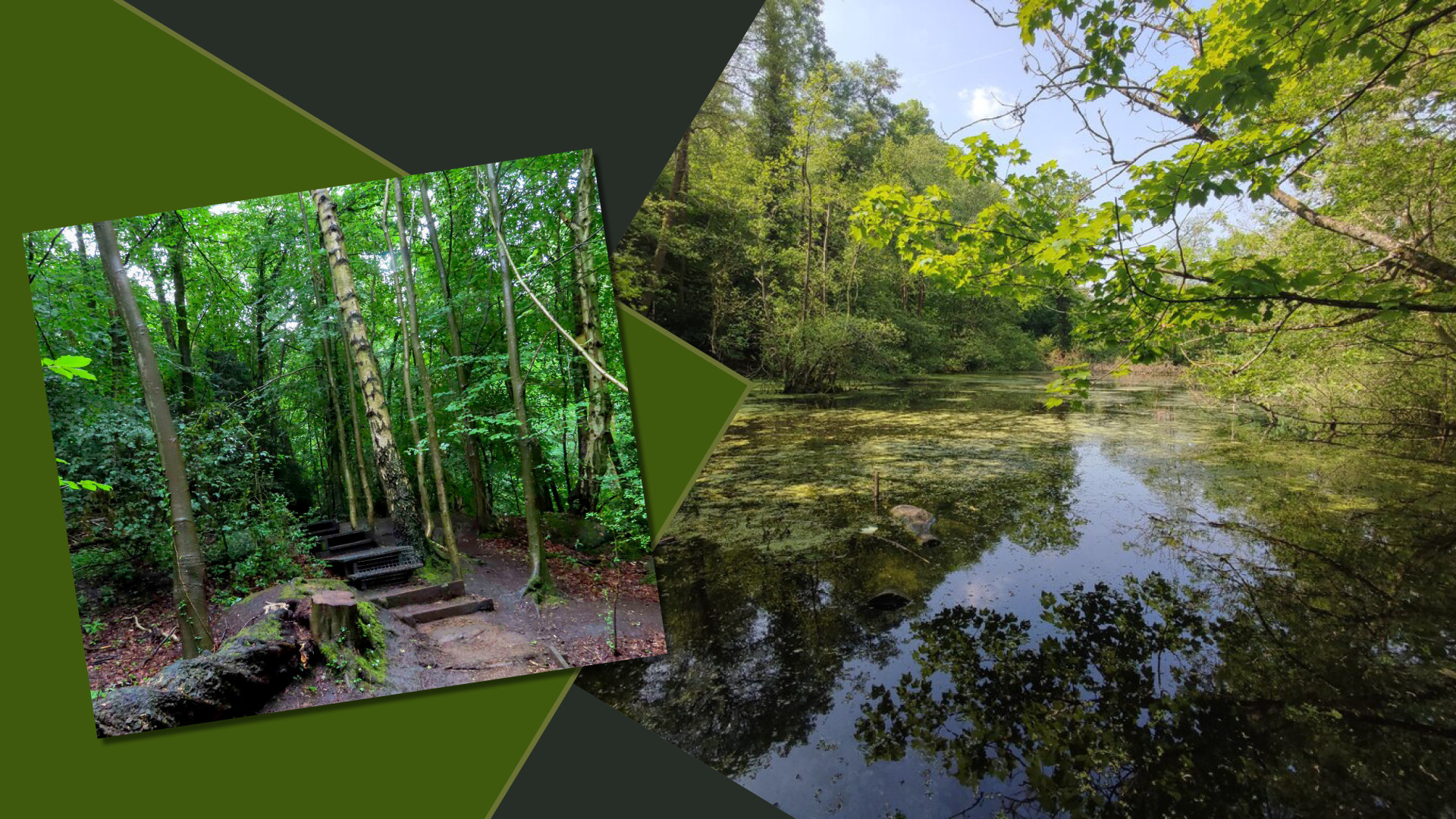
Finally, you can enjoy the Woodland Avenues via a path taking you round the Big Lake, perfect for a hot summer’s day. As you return to the house you will see an arch leading to an outdoor swimming pool where you will find frescoes on the walls and the vaulting of the archway painted by John Hastings during the late 1930s. Also to be found to the east of the house is the Theatre Pavilion constructed in 1938 for the second Lord Faringdon. Seating just 62 people the theatre has been restored with the equipment and facilities upgraded. Concerts are advertised on the Buscot Park website.
The grounds and house are open until 30th September. For more information visit