


As the summer sun encourages us to explore Oxfordshire and beyond, Esther Lafferty meets artist and sculptor Louise Regan who is inspired by the buildings she sees around her. Louise has appeared on the BBC’s Make it at Market and also I Made it at Market, which was broadcast in April.
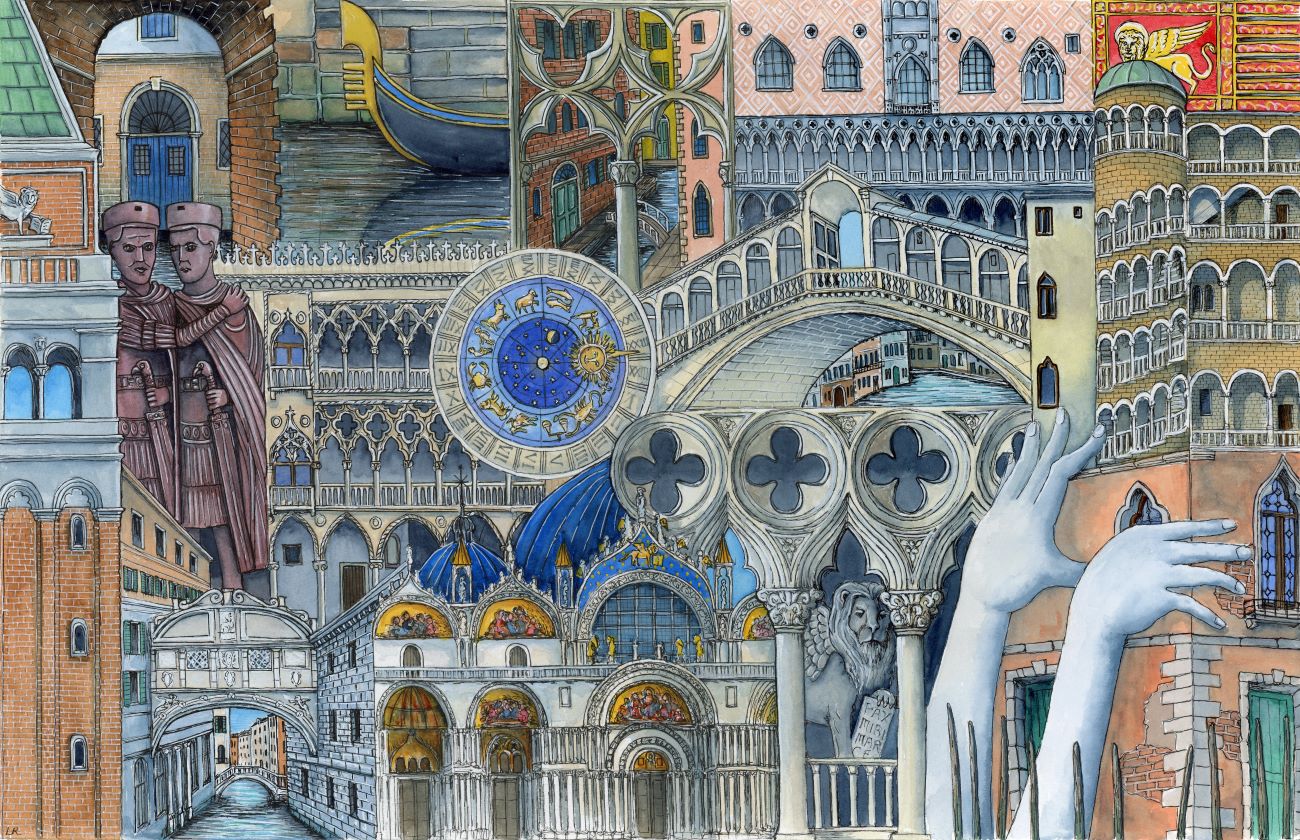
Louise is best known for her architectural montages or ‘melanges’, painted in ink and wash with plentiful colourful gouache. A recent painting incorporates 16 interesting buildings from across the Cotswolds, including Cirencester’s St John the Baptist Church and Bliss Mill in Chipping Norton with its iconic chimney. “I haven't only chosen typical Cotswolds buildings,” Louise explains. “In the line-up you’ll see Sezincote House with its weathered-copper onion dome, harking back to India, and the quirky family butcher's shop in Northleach, with its black and white timbers.”
Louise’s depictions also include Banbury, Woodstock and Charlbury, as well as Stratford-upon-Avon, London and Venice, and a montage of Europe; spanning the architecture of a continent to celebrate the diverse culture, history and national identities.
“It was a real challenge – I chose buildings that were built in different shapes, styles, and colours and, rather like a jigsaw, it took me three hours to work out in what order I was going to place them on the paper. I learnt lots along the way, including, for example, there are that 287 different languages spoken in Europe. I included Kosovo, and I felt sadness when I was adding Kyiv's cathedral. I also included Russia – St Basil’s is the most crazy, fabulous building.
You’ll often spot a touch of whimsy. Look out, for example, for a small duck hidden in the painting of Woodstock, amongst the town hall, church and museum buildings. I included him because when I visited the town to choose and sketch the buildings, I saw ducks everywhere, even wandering into shops,” Louise smiles. “However, I’m told they were becoming rather a nuisance and they’ve since been rehoused at one of the lakes in Blenheim.”
The dramatic gates to Blenheim Palace are also included in the artwork. “I simply love them,” she says. “They have such grandeur and a sense of the past. You can't help but wonder who's gone through them over the years.
I’m always excited by the history you can unravel by looking at the buildings wherever you are. You see hints of the alterations made over the centuries, whether to serve a different purpose or because of changing fashion – it was often about keeping up with the Joneses.
Architecture is an art form that people don't appreciate. There is such symmetry, style, and detail. If I go to a new town or city, I need someone looking out for me: I've fallen off curbs, walked into lampposts, into people, and my daughter had to save me from walking in front of a car in Trafalgar Square because I was too busy looking up,” she laughs.
“We lived outside Oxford when she was small and often visited our favourite grotesques. Did you know a gargoyle is actually a waterspout? The word gargoyle is derived from the same root as the word gargle so it’s actually part of a building’s plumbing. A grotesque is simply ornamental, an animal or human form. We both adored them, especially those on Brasenose College and down Queen’s Lane – we’d make up imaginative stories about what they did at night when we were sleeping.
I was also intrigued by the skill required to carve them, as well as the longevity of stone. If you take the time to really notice our buildings you will start to see the ‘tooling marks’: the marks left by the stonemasons’ chisels hundreds of years ago.”
It was seeing these marks, and the shapes, details and characters, on the buildings she was drawing that inspired Louise to take up stone carving, and she began chipping away herself five years ago.
Louise chuckles that her love of architecture is in her DNA. Coming from a family of builders (six generations on her father’s side). It is perhaps no surprise that when she took the brave leap to leave formal employment and became a full-time artist in 2020, she began studying stonemasonry, creating her own characters and creatures, windows, and doing relief and letter carving, too.
“I did some work experience with an Oxford architectural stone carver and ended up on a scaffolding at Magdalen College cleaning a 500-year-old sculpture of Moses with a toothbrush,” she laughs.
“Oxford’s wonderful, but you can also find inspiration in humble village churches around the county by looking at how foliage and animals have been carved. For example, there is a beautiful spreadeagle lectern in the church in Cropredy (where I live) which I studied when I was working out how to carve feathers. That said, I tend to free carve so although I have an idea in my head, other characters might emerge. Recently I started on a dragon but as I was I roughing him out, I saw he wanted to be a winged lion instead. I love that stone-carving is always such an adventure.”
See more at louisereganart.com