


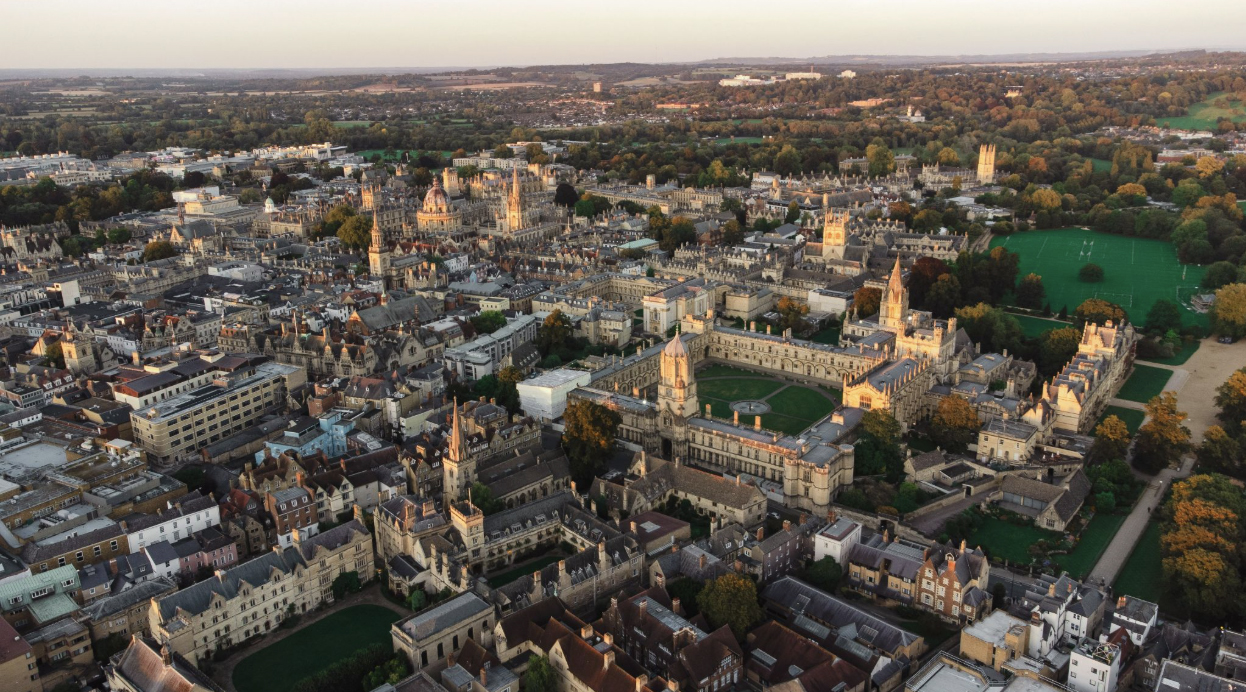

Oxford’s 2026 Recalibration
Oxford’s property market has been one of the UK’s most closely watched regional markets, and 2026 is showing the city’s most complete recalibration since the pandemic. Office for National Statistics figures put the average Oxford house price at £475,000 in April 2026, up 3.3% on the same month a year earlier. Home-mover average prices reached £580,000, up from £561,000, while detached homes averaged £970,000. Beneath those figures sits the real story: property-type divergence, sub-market variation, faster rental growth, moderated transaction activity and infrastructure reshaping parts of Oxford.
Why Oxford Still Sits Apart
The comparison with wider markets is instructive. Across the South East, average prices sit at £377,000, broadly unchanged year on year. Across Great Britain, home-mover prices average £332,000. Oxford sits substantially above both, sustained by the University of Oxford, Oxford University Hospitals, the science and technology sector, constrained land supply, conservation sensitivities and London-adjacent professional demand.
For Oxford homeowners and considered buyers, local agent performance data matters more in a recalibrated market. GetAgent is the UK's leading estate agent comparison platform, supporting Oxford homeowners who want to compare Oxford estate agents by local performance, sale prices achieved, time on market and fee structures. According to Peter Thum-Bonanno, Co-Founder and CTO at GetAgent, the Oxford data set reflects a market where sub-market specificity matters more than at any recent point, and where agent choice can affect outcomes differently than during the 2021 and 2022 rush.
Oxford’s 2026 property story is a quieter, more revealing shift: selective growth, rising rents, constrained supply and neighbourhoods moving at different speeds.
Where The Growth Is Really Coming From
Property Type Divergence
The 3.3% headline growth conceals meaningful divergence by property type. Semi-detached and terraced homes have grown more strongly year on year, while detached homes remain at high absolute price points. Flats, by contrast, have been broadly flat, with some smaller-home sub-markets showing weaker momentum.
The divergence reflects buyer behaviour in a more considered market. Family homes with garden space, storage and layouts suited to hybrid working continue to attract demand. Smaller flats face a more cautious buyer pool as office-based working patterns return and borrowing costs remain front of mind.
Sub-Market Variation
Oxford’s sub-markets increasingly behave as distinct micro-markets rather than one citywide market. The historic core, North Oxford, Summertown, Headington, East Oxford and Cowley each answer to a different buyer logic. Period stock, family housing, hospital-linked demand, student pressure, affordability and regeneration all carry different weights depending on the street, price point and property type.
An Oxford home is judged by location, condition, buyer demand and comparable local evidence, not citywide averages alone.
The Infrastructure Dimension
The £161 million Oxford Station upgrade, part of the Oxfordshire Connect programme, is a material infrastructure project. Botley Road is due to fully reopen in August 2026, while the wider works are intended to support a new platform, improved pedestrian and cycling access, and better rail connectivity for Oxford.
Neighbourhoods particularly affected include Jericho, Osney, the Botley Road corridor and the city-centre fringe. East-West Rail continues to progress, with implications for the Oxford to Cambridge corridor. The Oxford Local Plan 2036 continues to shape where future homes can realistically be built.
An Expert's Opinion On Oxford’s More Selective Market
“Oxford’s 2026 data shows a more selective market than the one sellers became used to in 2021 and 2022,” says Peter Thum-Bonanno, Co-Founder and CTO at GetAgent. “Across the city, we are seeing clearer differences in sale-price-to-asking-price ratios, time on market and fall-through patterns depending on property type, price point and neighbourhood. In that kind of market, sub-market specificity matters: the right agent for a family house in one part of Oxford may not be the right fit for a flat, period home or investment property elsewhere in the city. For homeowners, the practical lesson is that pricing judgment, local performance data and property-type experience now carry more weight than they did in the faster market that preceded it.”
The Rental Market Is Carrying More Heat
If the sales market is more measured, the rental market remains under pressure. ONS private rental data shows Oxford’s average monthly private rent reached £1,958 in May 2026, up 6.6% from £1,837 a year earlier. That is above the South East average of £1,418 and the UK average of £1,383.
Terraced and flat rents rose by 6.7% year on year, while detached rents increased by 5.9%. The pattern reflects familiar Oxford pressures: students, hospital staff, university employees, professional households and short-term relocators competing within limited rental stock.
The gap between sales growth and rental growth matters. It can support selective investor interest where purchase price and achievable rent still work, but it also deepens the affordability challenge for renters hoping to buy.
What Sellers And Buyers Should Read Into 2026
For sellers, the lesson is discipline. This is not a market that forgives vague pricing, tired presentation or incomplete paperwork as readily as the faster market once did. Well-presented, sensibly priced homes are better placed to perform.
Marketing periods are likely to be longer than in 2021 and 2022. Buyers have more room to negotiate, mortgage costs remain relevant, and the first listing price carries more consequence.
For buyers, the question is not simply whether Oxford is rising or falling. It is which part of Oxford, at which price point and for which property type. A family house in North Oxford, a flat in East Oxford and a period home close to the centre are not interchangeable propositions.
Rate expectations remain central. Bank Rate stood at 3.75% following the June 2026 Monetary Policy Committee decision, with the future path still dependent on inflation, confidence and wider economic conditions.
Where The Trends May Go Next
Forecasts for 2026 remain moderate rather than exuberant. Major UK housing market commentators have pointed to modest growth expectations, with the outcome dependent on rates, inflation, employment and confidence.
Oxford’s high-value position may limit rapid growth while affordability remains stretched. Yet its structural strengths remain intact. The university, hospitals, science economy, conservation areas and green belt constraints are part of the city’s housing architecture.
The most likely picture for the rest of 2026 is continued modest growth, meaningful property-type variation and elevated rental pressure. A material change in Bank Rate expectations would alter that picture.
Oxford Rewards The Considered Reader
Oxford’s property market in 2026 is not the fast-moving market of 2021 or 2022, but it is not a weak market either. The recalibration reflects broader UK market conditions rather than Oxford-specific weakness.
The city’s structural strengths continue to drive demand, particularly for well-configured family homes in established sub-markets. Presentation, sub-market specificity, agent choice and pricing strategy all matter more than they did in the faster market that preceded it.
Oxford’s property market rewards considered reading in 2026. The homes that sell well are the homes that meet current buyer priorities in their specific sub-market. The agents that perform well are the agents that understand this. The data is now clearer than at any recent point.
This article is for general information only and does not constitute estate agency, financial, legal or property advice. UK estate agents are regulated through membership of either The Property Ombudsman (TPO) or the Property Redress Scheme (PRS) and operate under the Estate Agents Act 1979, the Consumer Protection from Unfair Trading Regulations 2008, and Material Information disclosure requirements. Property market forecasts are inherently uncertain and are affected by economic, political and local factors. Buyers and sellers should consider their individual circumstances when making property decisions.