


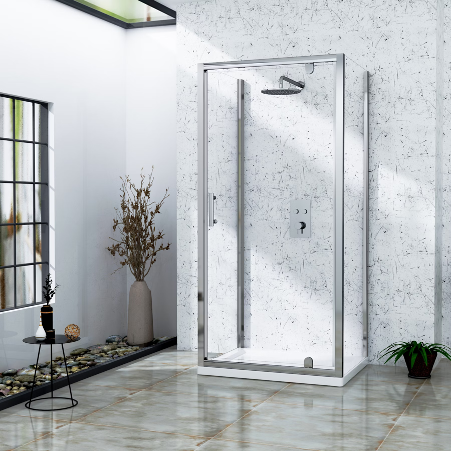

Buying a new shower enclosure or cubicle can be exciting, but getting the measurements wrong is a costly mistake. Precision is everything, whether you are a DIYer or a renovator. Shower enclosures are designed with a few millimetres of tolerance, but you need to provide the correct "wall-to-wall" or "edge-to-edge"measurement for a perfect, watertight fit.
In this blog, we will discuss how to measure a shower enclosure and provide you with all the information you need to measure and choose the right size shower enclosure.
What You'll Need
You will need the following tools for a measurement of a shower enclosure.
- A steel tape measure
- A pencil and paper
- A spirit level
Additionally, a helper (optional but recommended) will make the task easier.
*All these tools are easily available from a local hardware store.
Measure the Width and Depth (The Footprint)
This is the most critical step and defines the size of the shower tray or enclosure base you will need.
Remember!. Always measure the distance from finished wall to finished wall.
For a Corner or Three-Sided Enclosure
A corner enclosure ( rectangular shower enclosure or square shower enclosures that fit against two walls, and a three-sided enclosure against one wall (or recess).
- Measure the Width: For a square or rectangular enclosure, measure the length of the wall the shower door/panel will run along.
- Measure the distance from the finished wall to where the edge of the enclosure will meet the finished wall.
- Crucial Tip: Measure this length at three different points: the top, the middle, and the bottom of the desired shower height. Walls are rarely perfectly square or plumb.
- Measure the Depth (Return Panel Side): Measure the distance from the finished wall to where the side panel will end.
- Again, measure this depth at the top, middle, and bottom.
- Don’t forget to write down your smallest measurement for both the width and depth. Manufacturers build in tolerance, so the smallest reading ensures the enclosure framework will adjust to fit the tightest point.
- Standard UK Sizes: The most common dimensions you'll find when shopping are 800 x 800mm and 900 x 900mm for square/quadrant, and 1200 x 800mm for rectangular enclosures.
Measure the Height
The height is the measurement from the floor or the top of your shower tray up to the ceiling or the point where the enclosure will stop.
- If you are using a Shower Tray: Measure from the top edge of the shower tray upwards to the desired height (usually up to the ceiling or where wall tiling ends).
- If you are installing a Wet Room (no tray): Measure from the finished floor level upwards.
Action: Take the measurement in at least two places and write down the smallest value. Standard enclosure heights in the UK are often 1850mm, 1900mm, or 1950mm.
Check for Obstacles & Doors
The shower door should easily be able to open without any problems. Therefore check for door swing and clearance.
Door Swing Clearance
This step is vital for Hinged or Pivot doors, which swing out into the bathroom.
- Measure the full sweep of the door to ensure it won't hit the sink, toilet, radiator, or any other bathroom furniture.
- Sliding Doors, Bi-fold Doors, and Quadrant Enclosures are excellent space-saving options as they don't require external swing clearance.
Ceiling Fixtures
Check that the top of your enclosure won't clash with any light fixtures, extractor fans, or decorative coving.
If this is a new installation or replacing the shower tray, it is a good idea to check the location of the waste pipe. Most shower trays available in the UK are reversible or have a central waste, but it's worth checking the current pipework location to save time and cost.