


When Jim Keeling met Dominique both were students at Cambridge University. Did they imagine that 50 years later they would be celebrating the anniversary of their world-renowned pottery business? Whichford Pottery has earned a global reputation for producing the highest quality, handmade, frostproof terracotta flowerpots.
Whichford Pottery, located just over the Oxfordshire/Warwickshire border near Shipston-on-Stour, was founded in 1976 after Jim had completed an apprenticeship at Wrecclesham Pottery in Farnham. Founded by Absalom Harris in 1874, it specialised in flowerpot production. The workshop where Jim trained had changed extraordinarily little over the decades, and he took over the kickwheel of a potter called Harry who had only just retired – aged 83. Jim took the valuable skills he learned and implemented them when he and Dominique moved to Middle Barton where they started to produce flowerpots made entirely by hand in a friend’s barn. As the business grew, they relocated to their current site, and Whichford Pottery developed into a family business.
Whilst Jim was responsible for making the pots, Dominique pursued her early love of drawing and storytelling. Once their five children were of an age, she was able to spend more time on business interests and discovered a wonderful opportunity to combine drawing with pottery. Dominique took Jim’s domestic ware and decorated it with sgraffito – a technique which involves scratching designs into damp slip – letting it flow and dance across huge platters, jugs and bowls. This same dynamic energy drives her many layered mixed-media works. Familiar representational forms morph into palimpsests of nature and mythological images inspired by the surrounding Warwickshire landscape.
Eldest son Adam now leads a team of over 25 exceptionally talented craftspeople whilst youngest daughter Theodora heads up the sales, marketing and logistics teams. Their eldest daughter, Maia has turned her talents to hospitality, and, with her partner Christine, the two run The Straw Kitchen, an onsite café. Moreover, over the decades, the business has not only kept traditional ancient hand-thrown and hand-pressed methods and skills alive but has helped to sustain a local rural working community.
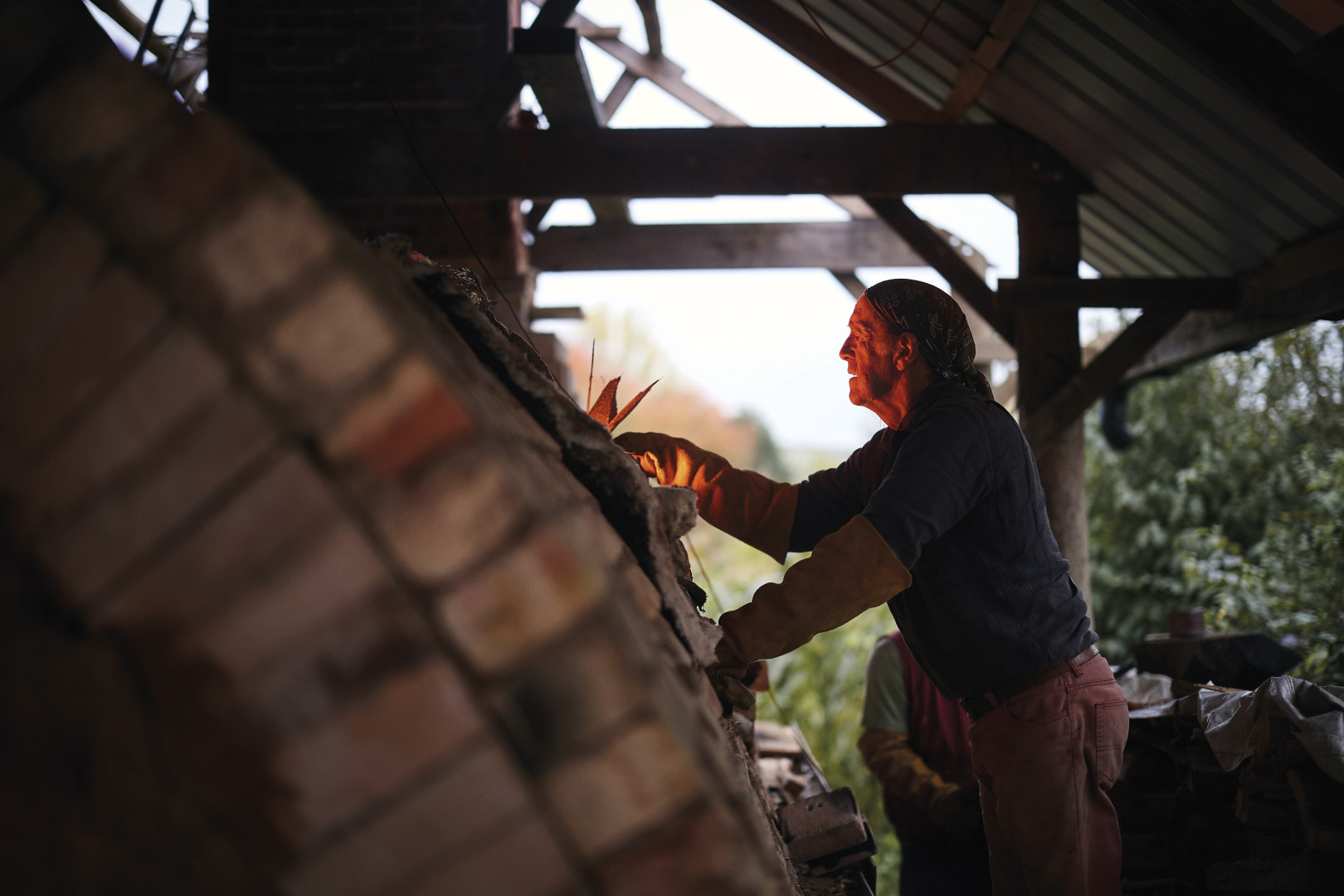
Inspired by a visit to Japan in the 1990s, Jim, Adam and the team installed a wood-fired kiln at Whichford Pottery, sufficiently large to house and fire large sculptural pieces and Ali Baba jars. Following a design process in excess of 15 years, the kiln combines elements of Japanese tradition together with North American and European techniques. The entire process of firing the 6m long kiln, from loading to unloading, takes around four weeks and relies on a dedicated team of skilled stokers. The end result creates extraordinary textures and finishes with no glazes required. No two parts of the object are the same; each tells its own story, and the kiln opens up many creative opportunities.
When it comes to the design of their pots, Jim has built on the skills and aesthetic of the British flowerpot tradition and developed these traditions into the unique and instantly recognisable Whichford style. Each pot they make is designed in-house, using hand-carved moulds, roulettes and stamps. This means that a Whichford Pottery pot is a thing of beauty in its own right, destined to become a collector’s item of the future.
It is the pottery’s individual blend of clays that allows them to offer a ten-year frostproof guarantee on all their rich terracotta pots. They combine clays from nearby Blockley with clay from Ironbridge to produce a material with both elasticity for forming, and porosity for plants. Every week, between five and eight tons are produced; a process which has been overseen by Brian since 1998. This is used to form the the pots (many of which still follow the original designs) which are hand-thrown on a wheel using an ancient ‘three-pull’ technique. Passed down the generations, this skill takes at least 15 years to truly master and perfect.
A key element of what makes Whichford Pots unique is the way in which they are decorated. All of the hand carved roulettes are applied by the throwers on the wheel with the remaining details added by the decorating team once the pots have stiffened for a day or two. These highly skilled craftspeople apply intricate relief moulds along with hand-scribed messages, stamps, colour and other details to over half of the pots produced by the company. Items which cannot be thrown on a wheel are made using a ‘hand pressed’ method. The potters press slabs of pre-rolled clay into moulds, forming highly decorative pieces including ovals, animals, eclipses and other designs.
Every Whichford Pot is stamped with the Whichford mark and year of making. Look closely and you’ll also see that, in celebration of the company’s heritage, the throwers and decorators add their personal makers’ mark to every pot they produce before they are either sold at Whichford Pottery or sent to stockists all over the world.
As well as producing pots, Whichford Pottery offers range of tableware as well as wood-fired ceramics and bespoke commissions. The Pottery run courses for potters of all levels, and visitors are welcome to see the potters at work from Tuesday to Thursday. For more information including The Straw Kitchen’s opening times, visit whichfordpottery.com.