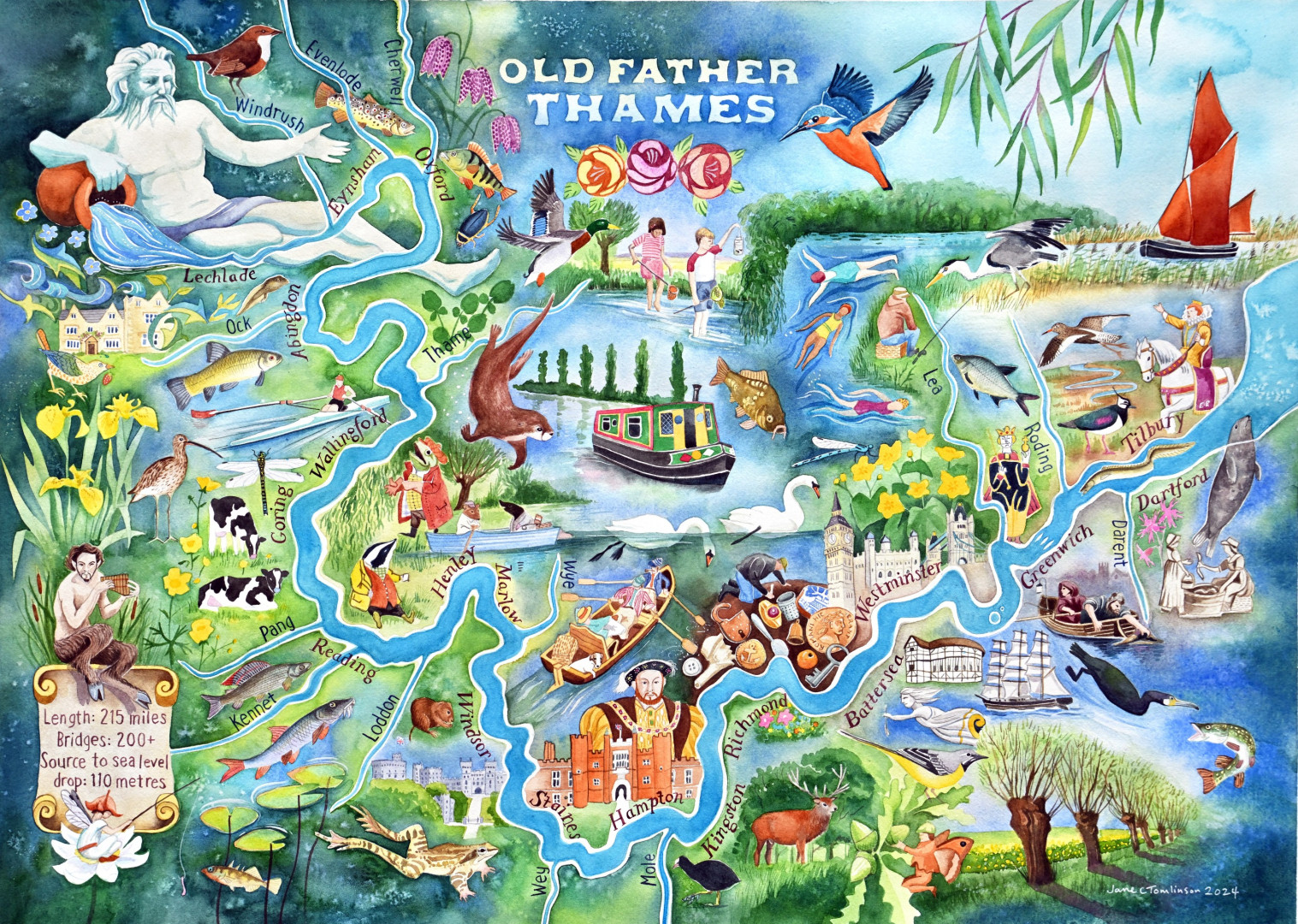
For this month’s edition, Oxfordshire Artweeks Festival Director, Esther Lafferty, spoke with artist Jane Tomlinson about her painting of Old Father Thames, the winner of the People’s Choice award in the Oxfordshire Museum Open Art Competition last year.
“My painting of Old Father Thames came about as I travelled on the train from my home near Eynsham to Richmond to visit our daughter,” explains Jane. “We crossed the river Thames seven times. In the public gardens opposite her flat is a tatty-looking sculpture of the river god Old Father Thames by John Bacon (1740-1799). He's seen better days for sure, and I think he looks annoyed because an irresponsible, greedy company is now using his once beautiful waters as a sewer. Politicians: are you listening? Birds not turds, fish not filth. Our rivers, including Old Father Thames, deserve respect and care, not exploitation.”
Although disappointed by the state of our rivers today, the statue got Jane thinking about a painting of the Thames.
“I thought, this is the deity whom every person in England should worship,” she explains. “Why? Because for two millennia, the river Thames has been central to the development of the English nation. It flows through every vein of our history, culture and daily lives and appears in some of our best-loved literature.
The river, and its tributaries, are as important in the history of England as the Nile is to Egypt. It has supported human settlement since the Neolithic era and been a vital trade route for centuries. Its place in our development as a society is impossible to understate. And it supports not just human life, but all kinds of living things.
My painting considers the many gifts that the river brings, it’s magic and bounty – clean waters, healthy habitats for all the creatures that need it, a place for humans to thrive. But how do you fit a river 215miles long onto a sheet of A1? I knew it would require some wrestling and gentle distortion to fit, and I’ve had to squash it up a bit, but the main meanders are shown.”
Jane has included a broad selection of places, wildlife, elements of the past, folklore and more in the work, for example canal art roses and the kids fishing for tiddlers. “I used to love doing that,” she grins. “A reliable water supply provides habitats for the wild creatures, and a place for humans to thrive. It’s a place for leisure too. In a space between a carp and the river Lea, I added some kingcups (marsh marigolds) plus an angler, and some wild swimmers.
I couldn’t include all the tributaries but the selection I chose includes the Windrush, Evenlode, Cherwell and Ock. And with so many important human settlements along the river, I had to carefully consider which ones to label. I couldn’t possibly name them all. I started at Lechlade, Gloucestershire, near the source of the river. Old Father Thames then continues through Oxfordshire: Eynsham, Oxford, Abingdon, Wallingford, Goring and Henley. From Reading, Berkshire it loops through Marlow and passes the castle at Windsor and Staines before entering Surrey. Somewhere around Hampton, Kingston, and Richmond, it becomes London, flowing past Battersea, Westminster and Greenwich.
This isn’t a painting about the Thames in London,” she adds, “but as Old Father Thames is so important to our capital city I have included a few of its landmarks: Big Ben, The Tower, and Tower Bridge.”
To the south of the river we see The Globe theatre – no surprise as Jane was born and bred in Stratford-upon-Avon – and the Cutty Sark which represents the long history of trading on the Thames.
South of Greenwich, a grim rowing boat is drawn from Jane’s favourite Charles Dickens' novel Our Mutual Friend. It shows Lizzie Hexham rowing out with her father to pull corpses from the water. Then, at Tilbury, Queen Eliabeth I is orating her ‘heart and stomach of a king’ speech, and in Hampton, there’s Henry VIII at his magnificent palace. “One of my favourite sayings (apart from Time flies like an arrow, fruit flies like a banana) is 'In 1515 Henry got his Hampton caught’,” she laughs.
Pictured just east of Westminster there’s a man mudlarking: the practice of searching the riverbank at low tide for historical objects; ephemera lost or deliberately cast into the river. “Illustrating mudlarking was a simple way of encapsulating two millennia of human settlement,” Jane explains, “I’ve shown some typical finds, which rather neatly sum up more than 2,000 years of human settlement: a button, an old clay pipe, a key, a fragment of broken pottery, a Roman coin.”
The much-loved The Wind in the Willows is illustrated just north of Henley, and on the map 'cartouche', which sits at the Piper at the Gates of Dawn (inspired by Arthur Rackham’s illustration) is playing his pipes on the far left. You’ll also see Jerome K Jerome’s Three Men in a Boat, and back in Oxfordshire, there’s Kelmscott Manor, home of designer William Morris.
Animals and birds to spot include the otter, the water vole, and the grey seal, who appears over near Dartford; the mute swan, the heron and the iconic kingfisher and ten species of fish from the stickleback and brown trout to pike; there’s even an eel.
Jane has also painted Take Me To The River which focuses on the Upper Thames. Half map, half landscape, it shows the river Thames from Eynsham, Oxfordshire, with an imagined view towards the Uffington White Horse. “This is my loose interpretation of a length of the river Thames I know well. It's my patch, my children's playground, a place I cherish. The entire river is liquid history, of course, and in most places here it's still wild, unkempt, and alive. Again I have tried to express something of the extraordinary richness of Mother Nature in this apparently quite ordinary landscape. I've even included an extinct species – the mammoth – which roamed free here until 10,000 years ago,” she explains. “The little train in the painting (the line from Bristol to London) is meant to suggest that we humans are just passing through this ancient and beautiful landscape.”
For more on these and similar works visit: janetomlinson.com
Old Father Thames is available as a signed print for £40, a greetings card for £3.35, a tea towel for £14.50 and a jigsaw puzzle for £32.50.