



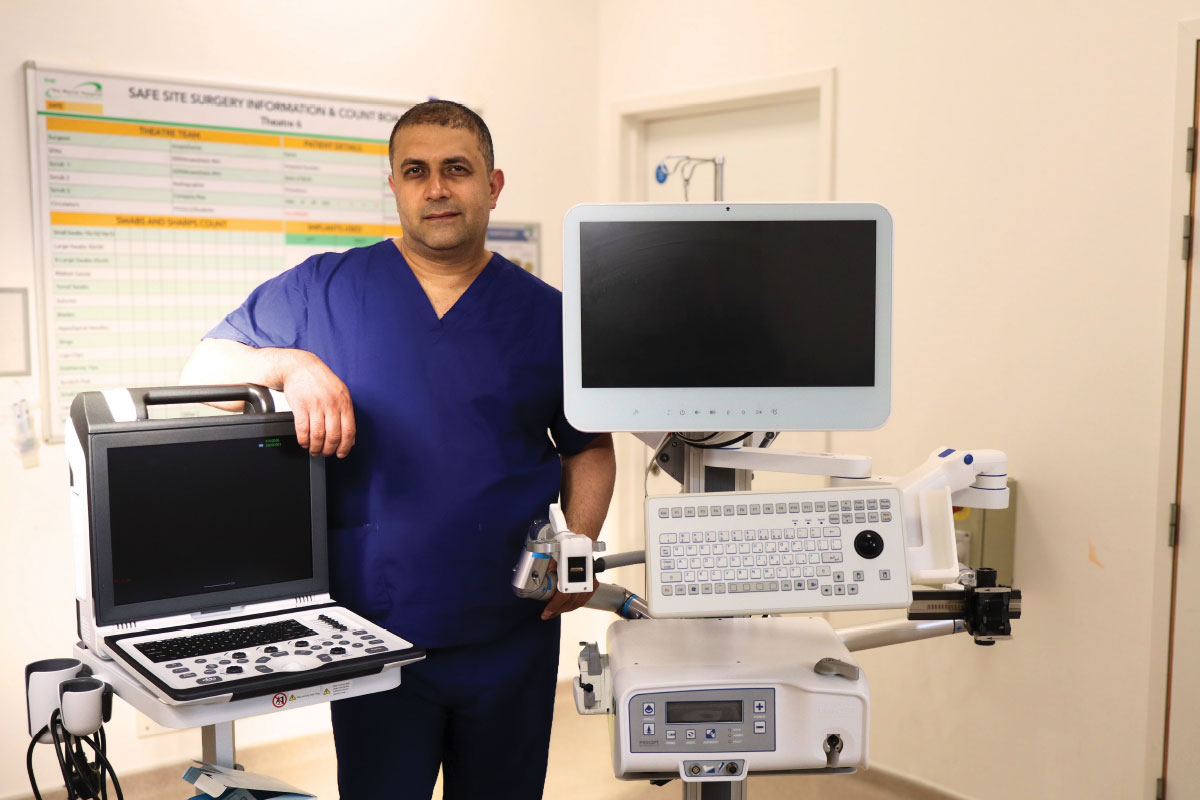
Needing to pee multiple times day and night, getting ‘caught short’, disappearing 10 or 20 minutes at a time to urinate and planning entire days navigating between toilets. If this sounds familiar, whether to yourself or someone you know, the good news is that a range of modern treatment options are transforming BPH management. Oxford-based Nuffield Health Consultant Urologist Mr Simon Brewster discusses breaking the taboos around BPH and the evolution of modern treatments.
It’s a condition that men often accept as part of getting older. By the age of 50, almost half of all men suffer from symptoms which can chip away at family, social and working life. Despite how common this progressive disease is, it’s often tolerated until complications develop, including urinary infection, kidney damage or painful retention of urine. However, benign prostate hyperplasia (BPH) is not something men simply have to live with: it is a treatable condition, where the path to recovery starts with breaking the taboo and seeking advice.
With his extensive experience as Consultant Urologist at the Manor Hospital in Oxford, Mr Brewster observes: “Before seeking treatment, many of my patients have been quietly suffering for several years from an enlarging prostate obstructing their bladders. In that time, their symptoms have worsened, quietly taking over their lives.”
He continues: “By the age of 50, up to 40% of men experience lower urinary tract symptoms. This rises to 90% by the age of 85. Advances in treatment mean men have access to a range of medical and surgical options that can improve or cure their symptoms. Men often see a urologist if drugs prescribed by their GP fail to improve their symptoms or cause side effects. The key during our consultation is pinpointing which approach fits best for them and their prostate. Men can choose which option suits them, weighing up the likelihood of a durable successful outcome versus the risk of side effects”
Aquablation therapy uses a robotic waterjet to remove obstructing prostate tissue without using steam or lasers, providing the surgeon with a 3D view of the prostate. Relatively new, hence long-term outcomes are unreported, it’s a proven alternative to established BPH interventions like TURP, HoLEP or Rezūm.
It carries a low risk of side effects: 99% of men are continent, 100% can maintain an erection and 89% preserve ejaculatory function according to clinical studies. It’s ideal for men who seek an elevated quality of life that allows for intimacy and the freedom to travel without the fear of losing bladder control.
If you’re affected by BPH, speak with your GP or urologist to consider a suitable treatment option for your prostate.