


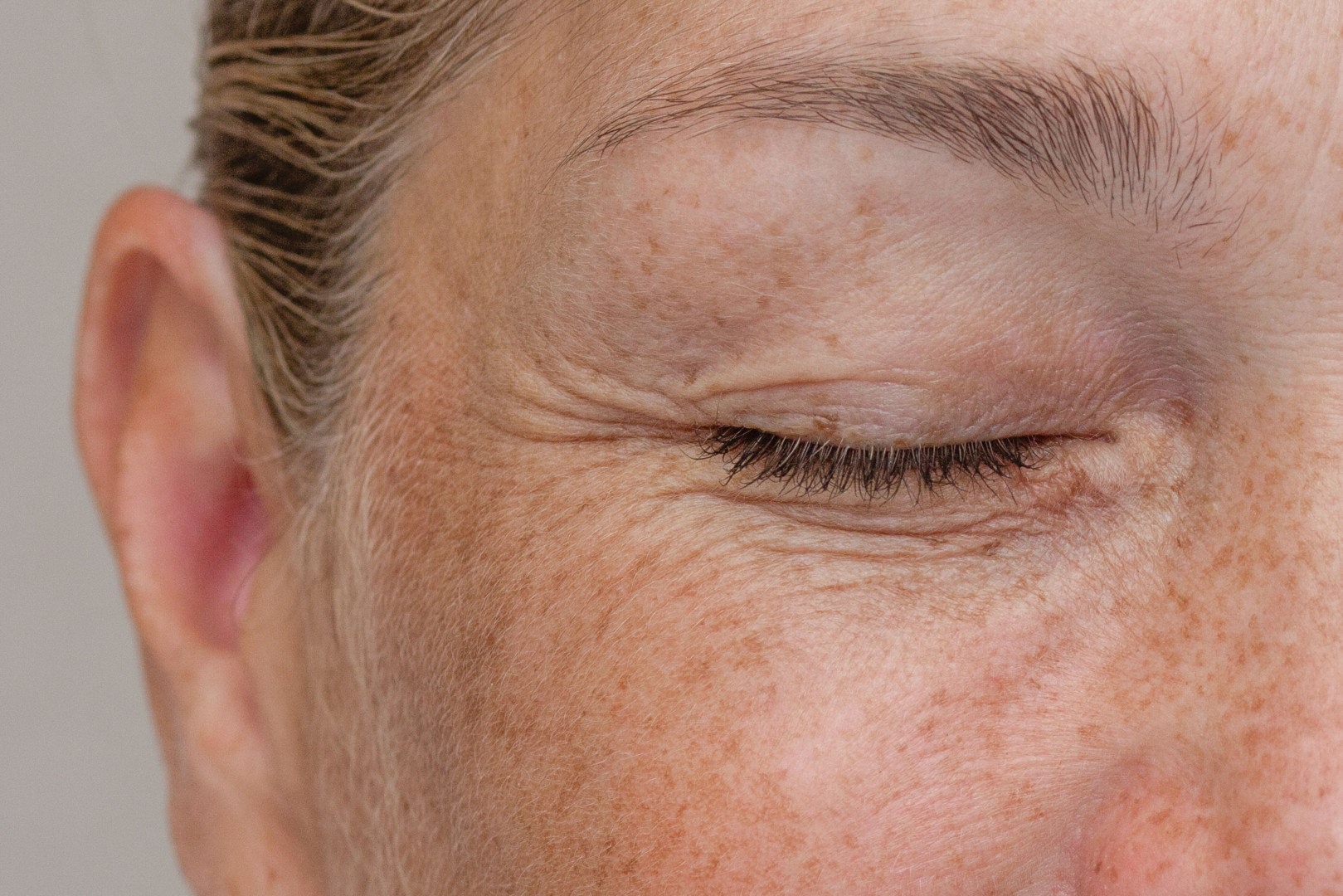

You can often see the first signs of facial aging in small, practical moments: mascara transferring to the upper lid, eyeliner that is no longer a smooth line, or eyes that do not seem to open as wide as they used to after a full night's sleep.
These changes are commonly attributed to wrinkles or loose skin, but the eye area ages in a more complex way. Its appearance is shaped by changes in structural proteins, hydration, cellular activity, and surrounding areas of the face. Genetics matter, but so do the biological processes that, over time, make eyelid skin less resilient.
Why eyelid skin shows age early
Understanding these processes helps explain why eye aging can include fine lines, puffiness, heavier upper lids, and loss of definition simultaneously. It also expands the conversation away from collagen, which has generally been the primary focus of anti-aging skincare.
Eyelid skin has fewer oil glands, making it especially susceptible to dehydration and environmental stress. At the same time, this fragile tissue is rarely at rest. Repeated blinking, smiling, and squinting place constant mechanical stress on the eye contour. Ultraviolet exposure is another challenge, as the skin's ability to repair itself diminishes with age.
Fine lines might be the most familiar result, but they are only the tip of the iceberg. The upper eyelids can seem heavier, the skin can become less firm, and the overall contour can look less defined. These changes indicate alterations within the tissue rather than just on the surface.
This combination helps explain why the eyes can show visible changes before other parts of the face. The tissue is delicate and constantly moving, and its ability to sustain and repair supporting structures is increasingly restricted. Collagen provides strength and structure, but firmness also depends on elastin, a protein that lets skin stretch out and snap back into place.
This ability to rebound is especially relevant around the eyes. Eyelid skin accommodates thousands of movements and expressions each day. In younger skin, elastin helps the tissue recover after each movement. As elastin declines with age, the skin becomes less capable of springing back, which can contribute to laxity and heavier-looking upper eyelids.
Hyaluronic acid plays a separate but complementary role by supporting hydration and volume. Collagen, elastin, and hyaluronic acid therefore contribute different qualities to the appearance of the eye contour: strength, flexibility and hydration.
The cells responsible for producing these components are called fibroblasts. As skin ages, fibroblasts become less active. Lower production of collagen, elastin, and hyaluronic acid gradually weakens the support that helps eyelid skin remain smooth, resilient, and well defined.
Seen this way, eye aging is not caused by the loss of a single substance. It develops as several interconnected parts of the skin’s support system become less effective.
Upper-lid hooding may begin beyond the eyelid
Treating the eye area as a collection of isolated concerns can be misleading. Under-eye bags, fine lines, and upper-lid hooding may appear in different places, but the surrounding tissues form a connected contour.
Ophthalmic surgeon Dr. Julia Sen notes that volume loss at the temples can contribute to upper-lid hooding. A change outside the eyelid itself may therefore alter how the lid sits and how open the eye appears.
This broader perspective has practical implications. Treating only the under-eye area may cause you to overlook changes in the upper lids and temples that are visible to the naked eye. The best ingredients for skin texture, elasticity, and reducing puffiness over time are those that support the production of collagen and elastin and improve microcirculation, says Dr. Sen.
The purpose of such care is not to create an artificial lifting effect. It is to improve skin quality across the entire eye contour so that the area looks firmer, healthier, and more refreshed.
Can skincare support the eye area’s repair processes?
Interest is growing in skincare approaches that work with the skin's existing repair mechanisms. One example is PTT-6, a proprietary signaling complex derived from ethically sourced red deer umbilical cord lining stem cells.
The finished skincare product does not contain living stem cells. Instead, PTT-6 contains naturally occurring proteins, growth factors, cytokines, and exosomes released by the stem cells. These signaling molecules help skin cells communicate and are being investigated for their ability to support healthier skin function.
Rather than replacing tissue, the intended approach is to encourage skin to behave more like younger skin. This distinction matters, particularly in a category where terminology related to stem cells can otherwise create confusion.
Laboratory tests found that the complex prompted eyelid fibroblasts to produce 68% more elastin and 113% more hyaluronic acid.
A clinical case series then evaluated an eye cream containing PTT-6. Following five weeks of consistent use, participants and investigators reported visible improvements in eyelid laxity, skin texture, and the appearance of eye bags. Most participants also showed improvements in fine lines and wrinkles.
Rethinking daily eye care
The research informed the development of Calecim Professional Eye Contour Lifting Cream as an under-eye wrinkle treatment. Reflecting the view that the eye contour functions as a connected area, the cream is designed for application beneath the eyes, across the upper eyelids, and onto the temples.
It focuses on sustained support for elasticity, hydration, and the skin's structural integrity, rather than a temporary tightening effect. That approach also offers a useful framework for evaluating eye products more generally. The eye area should not automatically be reduced to dark circles or under-eye wrinkles; upper-lid laxity, temple volume, and declining resilience can all influence how it ages.
Surgery may remain part of the conversation for some people concerned about hooded eyelids, but the question is no longer limited to how excess-looking skin can be removed or concealed. Research into fibroblasts, elastin, and cellular signaling is opening another line of inquiry: how the quality and resilience of eyelid skin might be supported before visible changes become more pronounced.
The central lesson is simple. Eye aging is a structural process, not merely a wrinkle problem. Collagen still matters, but elasticity, hydration, and the condition of the wider eye contour deserve equal attention.