Most people choose wall art the way they choose a cushion: they like the look of it in the shop, bring it home and find it somehow shrinks on the wall. A print that seemed generous in your hands ends up floating above a three-seater like a postage stamp. The fix is not better taste. It’s just a few simple measurements, and once you know them, sizing art over a sofa, bed, or mantel stops being guesswork.
Measure the Furniture, Not the Wall
The first mistake almost everyone makes is measuring the wall. A blank wall is a vague target, and it tempts you into choosing something that “fits” the space without relating to anything in it. Art above a sofa, bed or fireplace is not really hanging on the wall at all. Visually, it belongs to the piece of furniture underneath it, and that is what you should be measuring.
Grab a tape measure and note three things:
- The width of the furniture, measured across its widest point (arms included on a sofa, frame included on a bed)
- The height of the back, headboard or mantel shelf from the floor
- The height of your ceiling, which decides how much vertical room you have to play with
Write these down before you browse anything. Once you have them, every size decision in the rest of this guide becomes simple arithmetic rather than a matter of hoping it looks right.
The Two-Thirds Rule
The rule interior designers lean on most is straightforward: your art should be roughly two-thirds the width of the furniture beneath it. Some stretch it to three-quarters, but anything between those two points tends to look anchored and intentional. Go much narrower and the piece looks lost. Go wider than the furniture and it starts to feel top-heavy, as if it might tip forward.
Apply it to a standard 210cm three-seater sofa and the numbers get interesting. Two-thirds of 210cm is 140cm, and three-quarters is closer to 158cm. That means the ideal piece, or group of pieces, should span somewhere between 140cm and 160cm across.
This is where most people struggle. The size the rule demands is bigger than what most retailers offer, and the common poster formats top out at around 50x70cm or 70x100cm, so you either combine several pieces or look at ranges built for scale, such as Crib of Art’s XL+ paintings, which are made for exactly this kind of wide wall. Both routes work. What does not work is buying a 50x70cm print for a 210cm sofa and hoping the frame will make up the difference.
The rule also applies to height, just less strictly. Art should never be taller than the space between the top of the furniture and the ceiling allows, and on most walls, a piece that is between half and two-thirds of that vertical gap looks balanced.

Wall Art Over a Sofa
The sofa wall is where the two-thirds rule is most useful, as it is usually the largest piece of furniture in the room and the first wall people see. A useful starting point for the most common sofa sizes:
|
Sofa width |
Ideal art width (two-thirds to three-quarters) |
|
150cm (two-seater) |
100-112cm |
|
180cm (large two-seater) |
120-135cm |
|
210cm (three-seater) |
140-158cm |
|
240cm (large three-seater) |
160-180cm |
Leave a gap of 15-25cm between the top of the sofa back and the bottom of the frame. Any closer, and heads will brush the glass. Any higher, and the art disconnects from the sofa and starts floating on its own. If your sofa has a low back, stay nearer 25cm. If the back is high, 15cm is plenty.
Corner and L-shaped sofas cause the most confusion. Measure only the section of the sofa that sits against the wall you are hanging on, not the combined length of both arms. Treat that back section as if it were a standalone sofa and apply the same maths.
Furniture placement matters as much as art size. If your sofa floats in the middle of the room rather than against a wall, the art belongs on whichever wall the sofa faces or the one it is closest to, and the way you arrange your living room will decide which wall becomes the focal point. Settle the layout first and hang second, because moving a sofa after drilling six holes is a miserable afternoon.
Visual weight changes the picture too. A dark, busy or high-contrast painting reads larger than its actual size, so you can sometimes get away with the lower end of the range. A pale, minimal piece appears smaller and usually needs the full three-quarters width to look balanced.
Wall Art Over a Bed
The bed wall follows the same principle, but beds come in fixed sizes, which makes the arithmetic easier. In the UK, the standard widths and their matching art sizes look like this:
- Small double (120cm): art around 80-90cm wide
- Double (135cm): art around 90-100cm wide
- King (150cm): art around 100-112cm wide
- Super king (180cm): art around 120-135cm wide
Measure the headboard rather than the mattress if the headboard is wider, since that is the edge your eye uses as the boundary. Leave 20-30 cm between the top of the headboard and the bottom of the frame. Bedrooms usually have a more relaxed feel than living rooms, so you can hang a little higher here without the piece looking disconnected.
Orientation matters more over a bed than anywhere else. Beds are wide and low, so landscape pieces or a horizontal pair tend to echo the shape and look settled. A single tall portrait piece can work above a narrow single bed or a dramatic upholstered headboard, but over a king or super king it often looks like an afterthought.
Pairs and triptychs are especially good here. Two matching pieces centred over a double bed, with a gap of 5-8cm between them, read as one unit and create a sense of symmetry that suits a bedroom. Just make sure the combined width, including the gap, still lands in the two-thirds range.
Safety deserves a moment, because the bedroom is the one place where a falling frame lands on someone who is asleep. Large canvases and framed pieces can be surprisingly heavy, and a plain nail in plasterboard holds only a few kilos. For anything substantial, screw into a stud or use rated heavy-duty fixings, and skip glass in favour of acrylic glazing or an unframed canvas if you are nervous.
Wall Art Over a Mantel
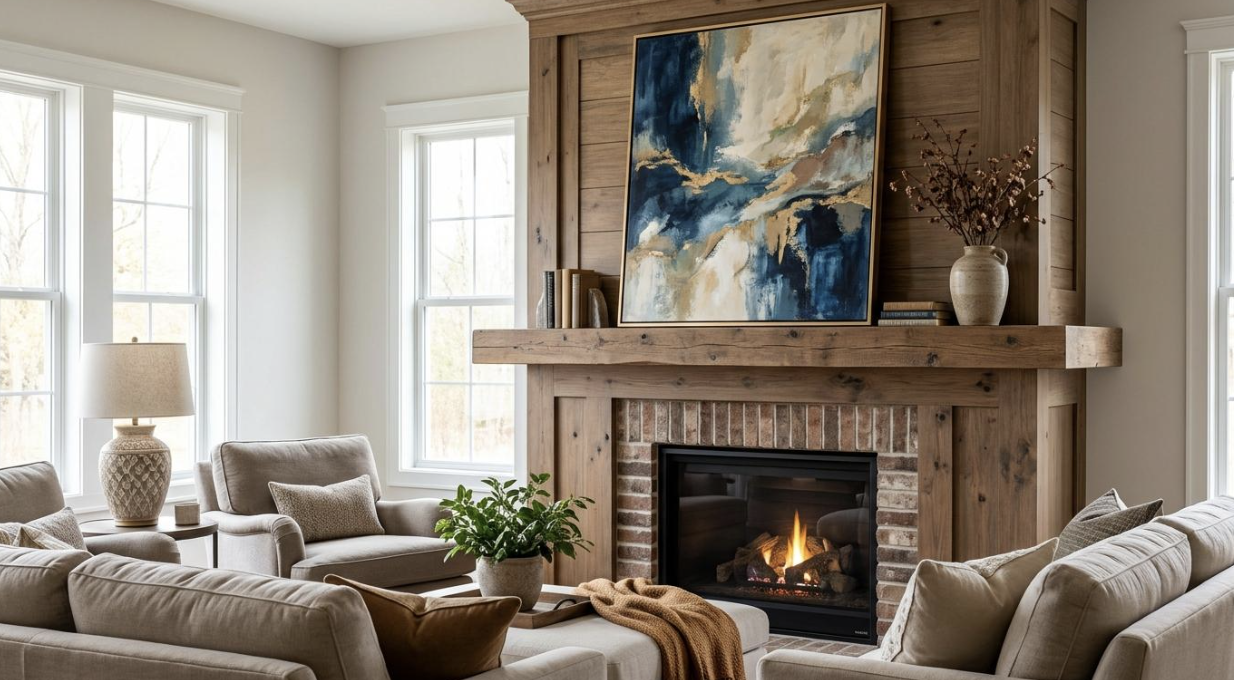
The mantel is the trickiest of the three, because it combines a shelf, a chimney breast and often a TV fighting for the same space. The two-thirds rule still applies, but measure the mantel shelf rather than the whole wall. A 150cm mantel suits art around 100-112cm wide, and the piece should never be wider than the mantel.
On a chimney breast, the breast often sets the outer limit instead. Art that extends beyond the edges of a protruding chimney breast looks awkward, so if the breast is narrower than the mantel, size it to the breast.
Hang the bottom of the frame 10-20cm above the shelf. Mantels give you two choices that other walls do not:
- Hang the art on the wall in the classic way, centred over the fireplace
- Lean a large piece on the shelf, which feels relaxed and lets you swap art without new holes
Leaning works best with a deep shelf and a piece that covers most of the mantel width. Layering a smaller piece in front of a larger one adds depth, but keep the arrangement to two or three objects. Mantels collect clutter faster than any other surface, and Marie Kondo’s approach to keeping only what genuinely sparks joy applies neatly here: a single strong painting beats a crowded row of frames, candles and postcards every time.
One practical warning. If your fireplace is in regular use, think carefully before hanging anything valuable above it. Heat, soot and rapid temperature changes make canvases expand and contract, which is why Ecclesiastical’s fine art care guidance advises against hanging paintings above fireplaces and radiators. If you light the fire most evenings, choose a print or a piece you would not mind replacing, and save original work for a cooler wall.
If a TV hangs above the mantel, art moves elsewhere. Splitting the wall between a screen and a painting rarely works, so give the TV the chimney breast and use the alcoves on either side for a pair of tall, narrow pieces.
How High to Hang Wall Art
On an open wall, the gallery standard is to hang art so its centre sits around 145-152cm (57-60in) from the floor, which is roughly average eye level. Over furniture, that rule gives way to the gap measurements above, because the art needs to relate to the sofa, bed or mantel beneath it rather than to an abstract eye line.
Ceiling height shifts things slightly. Rooms with high ceilings, common in Victorian and Georgian homes, can take taller art and a gap at the upper end of each range. In a modern home with 2.4m ceilings, stay at the lower end so the piece does not crowd the ceiling.
One Large Piece or a Set?
Both options can hit the two-thirds target. The best option depends on the room and your budget.
A single large piece creates a clear focal point and suits minimal or contemporary rooms. It is also quicker to hang, with fewer holes and less risk of a wonky arrangement.
A set or gallery wall suits more eclectic interiors and lets you build a collection over time. The key is treating the whole group as one piece when you measure. Lay the frames out on the floor, measure the outer edges of the arrangement and check that the overall span falls within the two-thirds range. Keep gaps between frames consistent, somewhere between 5cm and 8cm, so the group reads as a single block from across the room.
A common in-between option is the diptych or triptych, where one image is split across two or three canvases. It gives you the scale of a single large piece with the rhythm of a set, and smaller panels are easier to carry up stairs and through narrow doorways.
When to Break the Rule
The two-thirds rule is a starting point, not a law. A few situations call for something different:
- Very tall walls in double-height rooms can take a vertical piece that ignores furniture width entirely
- A deliberately oversized piece that spans almost the full width of a sofa can look bold and gallery-like, provided it is clearly intentional
- A small, precious piece can sit alone on a large wall if it is properly lit and has nothing competing with it
- Asymmetric arrangements, where art is offset towards one end of a sofa above a side table or lamp, can look relaxed and lived-in
What these exceptions share is intent. Breaking the rule works when it looks like a decision. It fails when it looks like you simply bought the wrong size.
Light, Damp and Where Not to Hang
Size is only half the decision. Where the art sits within the room affects how long it lasts. Direct sunlight fades pigments and paper over time, and walls next to radiators or heaters expose work to the same temperature swings as a working fireplace. New Zealand’s national museum, Te Papa, recommends keeping paintings away from heaters and out of strong light in its care advice for home collections. Choosing a shaded wall can help protect the artwork from fading and heat damage.
External walls in older homes can also hold damp, especially behind furniture where air does not circulate. If the wall above your bed or sofa feels cold to the touch in winter, use small spacers on the back of the frame to let air move behind it.
Test Before You Drill
Before committing to any size, make a template. Cut a sheet of brown paper or flattened cardboard to the exact dimensions of the piece you are considering, then tape it to the wall with low-tack painter’s tape. Live with it for a day or two, viewing it from the doorway, the sofa, and across the room.
This is the single most useful step in the whole process. A template shows you instantly whether a piece is too small, too high or too wide, and it costs nothing but a roll of tape. It is also the easiest way to settle a disagreement with whoever you share the room with.
Frequently Asked Questions
What size of art should go over a sofa?
Art over a sofa should be roughly two-thirds to three-quarters the width of the sofa. For a standard 210cm three-seater, that means a piece or group spanning about 140-158cm. Hang it 15-25cm above the top of the sofa back so it feels connected to the furniture.
What is the two-thirds rule for wall art?
The two-thirds rule says art should be about two-thirds the width of the furniture beneath it. It keeps the piece visually anchored without overwhelming the furniture. Some designers stretch it to three-quarters, and anything in between usually looks balanced.
How big should art be above a king-size bed?
A UK king-size bed is 150cm wide, so art above it should be around 100-112cm wide. Measure the headboard instead if it is wider than the mattress. Landscape pieces or a horizontal pair tend to suit the low, wide shape of a bed best.
How high should you hang art above a bed?
Leave 20-30cm between the top of the headboard and the bottom of the frame. Without a headboard, aim for 25-35cm above the mattress top. Use secure fixings, since the art hangs directly above someone sleeping.
Should art be wider than the mantel?
No, art over a fireplace should not be wider than the mantel shelf. Aim for about two-thirds of the mantel width. If the chimney breast is narrower than the mantel, size the art to the breast instead.
Is it safe to hang a painting above a fireplace?
It is fine for prints and inexpensive pieces but risky for valuable or original work. Heat, soot and temperature swings can crack paint and warp canvas over time. If you use the fire often, choose a piece you would be happy to replace.
What is the standard height for hanging pictures?
On an open wall, the centre of the art should be around 145-152cm from the floor. This matches average eye level and is the standard most galleries use. Over furniture, use the gap above the sofa, bed or mantel instead.
Is it better to have one large piece or several small ones?
One large piece creates a stronger focal point and suits minimal rooms. Several smaller pieces suit eclectic interiors and can be built up over time. Either works, as long as the overall width of the arrangement fits the two-thirds rule.
How far apart should frames be in a gallery wall?
Keep frames 5-8cm apart for most arrangements. Consistent spacing matters more than the exact figure, because it makes the group read as one unit. Measure the outer edges of the whole arrangement when checking it against your furniture.
What size wall art is best for a small room?
Small rooms still benefit from art that obeys the two-thirds rule, which often means one larger piece rather than many little ones. A single substantial piece can make a small room feel calmer and more considered. Many small frames tend to make a compact space look cluttered.
How do I know if my wall art is too small?
If the art is noticeably narrower than half the width of the furniture beneath it, it is probably too small. Another sign is that it seems to float on the wall rather than relate to anything in the room. Taping a paper template to the wall before you buy is the easiest way to check.
Final Thoughts
To get wall art the right size, measure the furniture, apply the two-thirds rule, and leave the right gap above the sofa, bed, or mantel. Those three steps cover almost every room in the house. Once the numbers are in place, you are free to choose the art you actually love, knowing it will look like it belongs there rather than like something you squeezed in.