

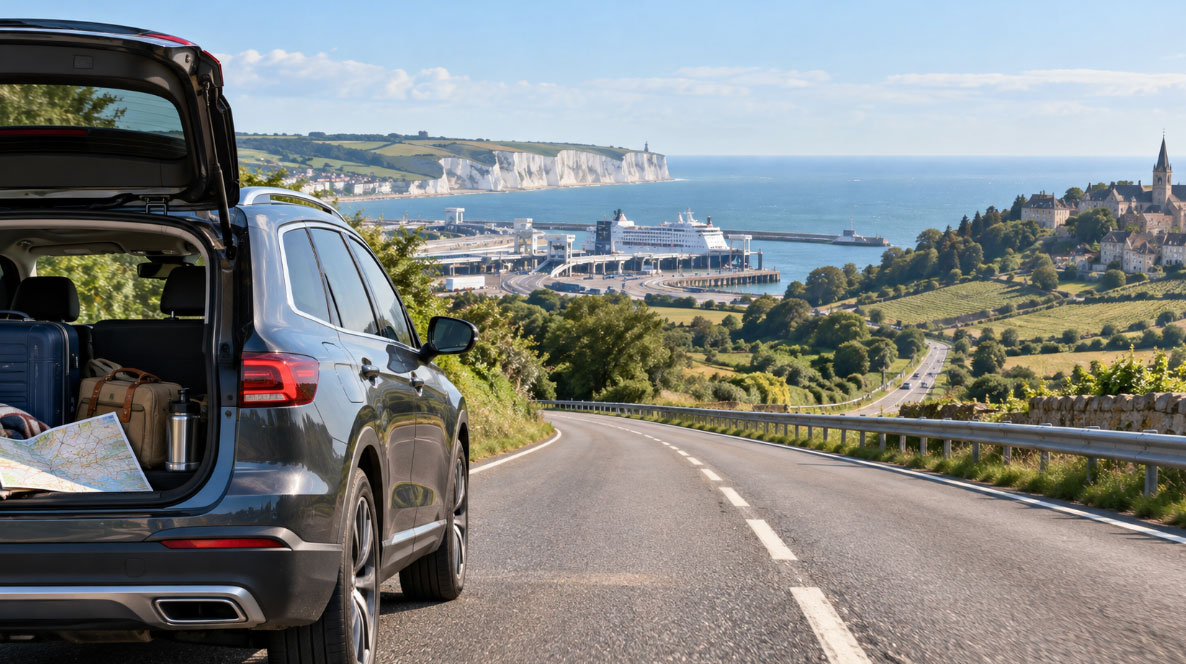

Why fly when you could just drive? It's a question plenty of Oxfordshire drivers have asked themselves while staring at a map, and the honest answer is: you probably can. A full UK driving licence, a passport with enough validity left, a bit of planning – that's most of it. The Continent is closer than it feels. The M40 to the M25, then the M20, and within a couple of hours drivers are at the Channel. From Calais or Dunkirk onward, the whole of Western Europe opens up. No departure lounge. No baggage limits. No rush.
Crossing the Channel: Eurotunnel or Ferry
Most Oxfordshire drivers heading south take the M40-M25-M20 route towards Folkestone, and from there the traffic splits two ways. LeShuttle – most people still call it Eurotunnel, old habits – loads cars onto a train at its Folkestone terminal, right off Junction 11A of the M20. Thirty-five minutes later, the car rolls off in Calais. Up to four departures an hour, running around the clock. Faster option, and there's no seasickness to worry about since the whole thing happens under the sea.
Ferries from Dover take longer, closer to 90 minutes on the water, but they let passengers actually get out of the car. Stretch the legs, grab a coffee, watch the White Cliffs shrink in the distance. Some people prefer that; others just want to be on the other side already.
Either way – arrive early. Both operators suggest checking in at least an hour before departure, and queues build fast during school holidays and bank holiday weekends. Worth building extra time into the departure from home, especially in July and August.
Should You Take Your Own Car, or Rent Once You Arrive?
Driving the family car all the way down to Tuscany, or the Algarve, has an obvious appeal. But is it always the smart move? Not necessarily. Every mile adds wear and fuel cost, and a UK-plated car parked in an unfamiliar Mediterranean car park is, frankly, a slightly more obvious target than a local hire vehicle. For anyone flying part of the way, or simply reluctant to put a few thousand extra miles on their own car, picking up a rental once you land is often the more sensible route.
This is where a site like localrent.com earns its place in the planning stage. Rather than booking through a single international chain, it pulls together cars from independent local rental companies across dozens of European countries – which usually means lower deposits and clearer pricing than the big-name counters at the airport tend to offer. For a two-week loop through southern France, or a scenic run through the Balkans, comparing a handful of local operators before committing can shave a genuinely noticeable amount off the total cost.
Documents and Insurance You Can't Skip in 2026
Post-Brexit paperwork has settled into something fairly predictable by now, though it's still worth double-checking before every single trip – rules do get tweaked. A UK photocard licence covers driving anywhere in the EU and EEA, no International Driving Permit needed. Passports need to have been issued within the last ten years and stay valid for at least three months past the planned exit from the Schengen area – and this detail, more than any other, is the one that catches people out at the border.
The old green card for insurance? Not required anymore for EU and EEA countries, hasn't been since 2021. Still worth a call to the insurer, though, to check whether a UK comprehensive policy stays comprehensive abroad or quietly drops to third-party only. And the "GB" sticker has been retired – it's a "UK" sticker now, needed on any car whose plate doesn't already show the UK identifier.
Planning to stay longer than a couple of weeks? Keep the 90-day rule in mind: UK passport holders can spend up to 90 days within the Schengen area in any rolling 180-day period, and days spent in different countries all count toward that same total.
The Legal Kit Every Driver Must Carry
Several countries expect specific safety kit to be in the car at all times, and roadside checks genuinely happen – this isn't just theoretical. A sensible kit for a France-Spain-Italy route should include:
- A warning triangle and a hi-vis vest for every single occupant (mandatory in France, Spain and Italy)
- Headlight beam deflectors, since UK headlights are angled for driving on the left
- A spare pair of glasses for anyone who needs them – required in Spain and Switzerland
- A first-aid kit, recommended almost everywhere in Western Europe and a legal requirement in parts of it
- Breakdown cover valid for driving in Europe, plus a GHIC in case medical treatment is needed
Tolls, Low-Emission Zones and Local Road Rules
Motorway tolls are just part of the deal in France, Italy, Spain and Portugal, so it's worth carrying a card that actually works abroad rather than relying on cash alone. Switzerland and Austria do things differently – a vignette, bought before joining the motorway, rather than pay-as-you-go booths. A number of French cities run low-emission zones tied to a car's Crit'Air sticker, and enforcement is automatic: cameras, not a warning on the spot. Get it wrong and the fine simply turns up by post weeks later. Speed limits shift with the weather too, in several countries – France drops its motorway limit from 130 km/h to 110 km/h when it's raining, and that's a legally enforced number, not a friendly suggestion.
Final Thoughts
None of this is complicated, taken piece by piece. It's the sheer number of small details that trips people up – a UK sticker instead of the old GB one, a passport that's valid but not quite valid enough, a hi-vis vest that got left in the garage. Sort it all out before leaving Oxfordshire, rather than at the ferry terminal with a queue forming behind, and what could be a stressful morning turns into a fairly straightforward one. Wherever the road ends up – Provence, Portugal, somewhere in between – the appeal of driving to Europe hasn't really changed. Nobody else sets the pace. And the best stops, more often than not, were never on the itinerary to begin with.