


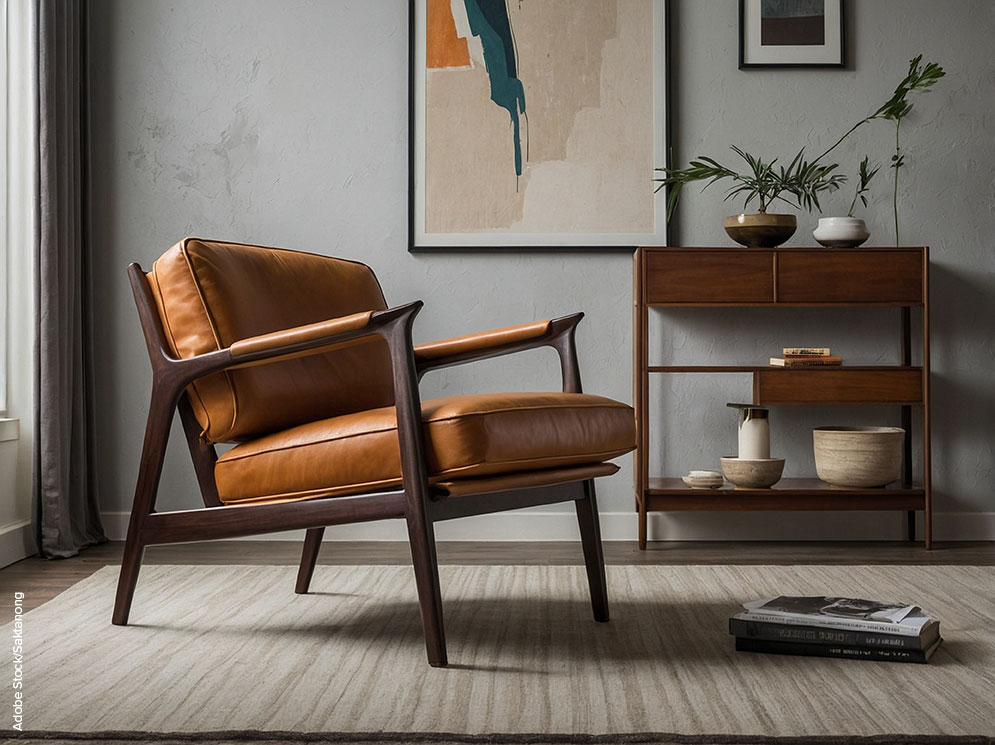

A room begins long before anything is delivered. It begins with the way light comes through in the late afternoon, with the proportions of a ceiling, with the tone of a floor laid decades ago and the colour on the walls above it. The furniture arrives into all of that, and either belongs or doesn't. The rooms that feel genuinely considered are rarely the ones assembled from a series of individually admired pieces. They're the ones where somebody looked at the space properly first and understood what it was asking for.
A piece of furniture changes in context
Anyone who has ordered a chair from a photograph knows the particular disappointment of seeing it in place. The form was exactly right. In the room, it reads as too formal, or too pale, or somehow smaller than it seemed — and none of that was visible on a white background.
Furniture is relational. A sofa is only generous or overbearing relative to the wall behind it. A cabinet's finish only works, or doesn't, alongside the flooring it stands on. Daylight in a north-facing sitting room will pull a warm oak somewhere cooler than the showroom suggested, and evening lamplight will pull it back again. Then there is the matter of how a room is actually lived in: whether people pass through it constantly, whether children use it, whether it is a place for reading or for gathering.
Visual-production studios such as CGIFurniture show how furniture and homeware brands can present products through lifestyle renders, white-background images, close-ups, 360° views, animations, and AR-ready assets, helping customers understand scale, material, and room context before making a decision. The lesson for anyone furnishing a home is straightforward enough: seek out the images that place a piece in a room, and be wary of committing on the strength of a beautiful object photographed alone.
Craft and material should lead the decision
Ask anyone who commissions furniture regularly what they look at first and the answer is rarely the shape. It is the material, and how it has been handled.
Wood carries the most information. Grain direction, the way a maker has matched adjacent boards, whether a finish has been built up in oil or sprayed on — these tell you what a piece will look like in five years as much as in five days. Fabric and upholstery behave similarly. A heavy linen creases and softens and becomes more itself with use; a tightly woven wool holds its shape and its formality. Metal introduces coolness and contrast, stone a certain weight and permanence.
This is where a well-made piece separates itself, and it is also why Oxfordshire and the Cotswolds have such a strong tradition of makers. Commission a cabinet locally and you can put your hand on the timber before it is cut, discuss the finish, see how a joint is going to be made. That kind of proximity to the material is a luxury in itself, and it removes a good deal of the guesswork that comes with buying at a distance.
Colour is easier to judge when the room is visible
Choosing colour from an isolated swatch is one of the more reliable routes to a mistake. A card held up in a bright shop tells you almost nothing about how the same shade will read against your walls, under your light, beside a floor that already has its own tone.
Everything is relative here. A green that seems muted alone can look surprisingly strong once a room is full of it. A grey with a warm undertone will fight with a cool wall colour in a way that is difficult to predict from two swatches side by side. Wood tones complicate things further, because a room with several different timbers in it needs those tones to be having a conversation rather than an argument.
The practical answer is to gather everything together and live with it for a few days. Paint samples on the actual wall, seen in morning and evening light. Fabric offcuts laid on the floor. Photographs of the existing furniture beside the pieces under consideration. Interiors change through the seasons too — a scheme that feels warm and enveloping in November can read as heavy by June, which is worth knowing before the sofa is upholstered.
Bespoke and ready-made need different checks
Both routes have their place, and each carries a different kind of uncertainty.
A commission is a conversation, and the visual checks are about alignment. Drawings that show the piece at true scale. Material samples to hold. Finish references and, if possible, a visualisation of the piece in the intended room, so client and maker are both picturing the same thing before the workshop begins. The cost of a misunderstanding here is high, which is why good makers front-load the discussion.
Ready-made pieces bring different questions. Exact dimensions checked against the room, including the route in — a great many sofas have been defeated by a staircase. Lifestyle images showing the piece at scale in a real interior. Close-ups revealing the material honestly. And the unglamorous logistics: delivery, assembly, and what happens if it is wrong.
A family home needs beauty and resilience
There is a particular kind of interior that photographs beautifully and cannot withstand a Tuesday. It is worth avoiding.
Rooms that get used daily need furniture that can take it. Hardwearing fabrics, or covers that come off and go through the machine. Surfaces that forgive a hot mug. Storage built in from the start rather than added once the clutter has won. Enough room to move through a space without navigating around precious things.
None of this needs to compromise the look of a room. The best designers working in family homes tend to argue the opposite — that a piece which can absorb real life is a piece you relax around, and rooms you relax in are the ones that get used and loved. Fragility is not the same as refinement.
Interiors are built through layers
A room is rarely finished by its furniture. The anchor pieces set the structure, and then everything else gives the space its character.
Lighting does more than any other single element to change how a room feels after dark — lamps at low level, a shaded pendant, something warm rather than overhead and flat. Rugs ground a seating arrangement and soften acoustics. Textiles add depth. Art gives the eye somewhere to go. Then the smaller things: ceramics from a local maker, books that are actually read, a candle or a bowl or an object brought back from somewhere. These accumulate slowly, and it is the accumulation that stops a room looking as though it arrived all at once.
Questions worth asking
- Does the piece suit the proportions of the room, not just its own?
- How will the colour behave in daylight and again by lamplight?
- Will the material stand up to how this room is genuinely used?
- Does it get along with the furniture already there — particularly the wood tones?
- Is this meant to be a statement, or should it be supporting something else?
- Can you read the shape and texture clearly from the images available?
- Does it feel right for the life that happens in this house?
Final thoughts
Interiors that feel considered are simply interiors where the thinking happened first. Light, proportion, material, colour, and the ordinary business of daily life — weigh those before choosing, and the pieces that arrive settle in as though they had always been there. Which is the point, in the end. A room ought to feel less like a collection of decisions and more like somewhere that grew into itself.